
I hear the same thing from veterans on benefit-based income: "I barely cover my bills. Where am I supposed to find money to save?" And I get it. When your monthly deposits come from disability compensation or a GI Bill housing stipend, the math feels locked in. There is no boss to ask for overtime. No side project bonus coming. What hits your account is what you have.
But that framing is the problem. Building cash reserves on fixed or semi-fixed income is not about finding extra money. It is about routing the money you already have so some of it accumulates before you spend it. The trick is doing that without bouncing a payment or eating ramen for two weeks.
This is not a pep talk about "paying yourself first." This is a walkthrough of how to actually do it when your income comes from the VA.
Why cash reserves matter more on benefit income
If you have a salaried job and your car breaks down, you can pick up extra shifts, sell PTO, ask for an advance. When your income is VA disability compensation, you have none of those levers. Your next deposit is the same as the last one. The only thing standing between you and a predatory loan is whatever cash you have sitting in reserve.
The 2023 FDIC survey found that 4.2% of U.S. households were unbanked and 14.2% were underbanked. Lower-balance consumers tend to get hit harder with fees, including overdraft and insufficient fund charges. If you are living on benefits with a thin checking account balance, you are one unexpected expense away from a fee spiral that costs more than the original problem.
Emergency savings are not about discipline or virtue. They are about buying yourself options when something goes wrong. And on fixed income, things going wrong costs more because you cannot flex your earnings to absorb it.
Which benefits are stable enough to build around
Not all VA income works the same for planning purposes. Some of it is predictable. Some of it is temporary. Knowing the difference matters when you are deciding how much to set aside each month.
VA disability compensation is the most stable income stream most veterans have. If you have a permanent and total rating, or even a stable rating that has been in place for years, that monthly deposit is about as reliable as it gets. It adjusts annually with COLA, it is tax-free, and it shows up on the first of the month. The FY2027 VA budget proposal includes $282.6 billion in mandatory benefits funding, up 7.9% above 2026, covering compensation and pensions. That money is legally required, not subject to annual appropriations votes the way discretionary spending is. More than 7.4 million veterans and survivors are expected to receive disability compensation in 2027.
GI Bill and VR&E housing stipends are different. They are tied to enrollment. When you are in school, the money flows. When the semester ends, it stops. When you graduate or exhaust your entitlement, it is gone. The VA expects education assistance programs to serve more than 1.3 million trainees in 2027, and VR&E benefits to reach more than 190,000 veterans. Those are big numbers, but your individual stipend depends on staying enrolled and making satisfactory progress. Do not build your baseline budget around a stipend that disappears in May and does not restart until September.
If you receive both disability compensation and a housing stipend, your compensation is the foundation. The stipend is the variable. Plan your savings rate around the foundation, and use the stipend months to move faster.
The savings ladder: $500, $1,000, one month, three months
Trying to save three months of expenses from zero is demoralizing. You do the math, the number looks impossible, and you quit before you start. So do not aim for three months. Aim for $500.
That is the first rung. $500 covers a tire blowout, an urgent vet bill, a last-minute bus ticket. It does not cover everything, but it covers the stuff that usually sends people to a payday lender. Getting to $500 means you have a buffer between your life and the worst financial products on the market.
Once you have $500 sitting untouched, the next target is $1,000. This handles slightly bigger problems: a car repair, an appliance replacement, an unexpected medical copay that VA does not cover. At $1,000 you start to feel like you can absorb a bad week without it becoming a bad month.
Then one month of core expenses. Not one month of income. One month of the things you actually have to pay: rent or mortgage, utilities, groceries, insurance, phone, transportation. Add those up. That is your number. For a lot of veterans on benefits, this is somewhere between $1,500 and $3,000 depending on where you live and whether you have dependents.
Three months is the real target. At three months of core expenses, you can survive a benefits processing delay, a move, a medical situation that takes you offline for a while. You have actual breathing room.
But you climb the ladder one rung at a time. Each rung changes what you can handle. Do not skip ahead mentally and get discouraged by the top.
How to route your money without wrecking your month
Here is where most savings advice falls apart for veterans on benefits. Someone says "save 20% of your income" and if your income is a $1,800 disability check, saving $360 means you are short on groceries by the third week.
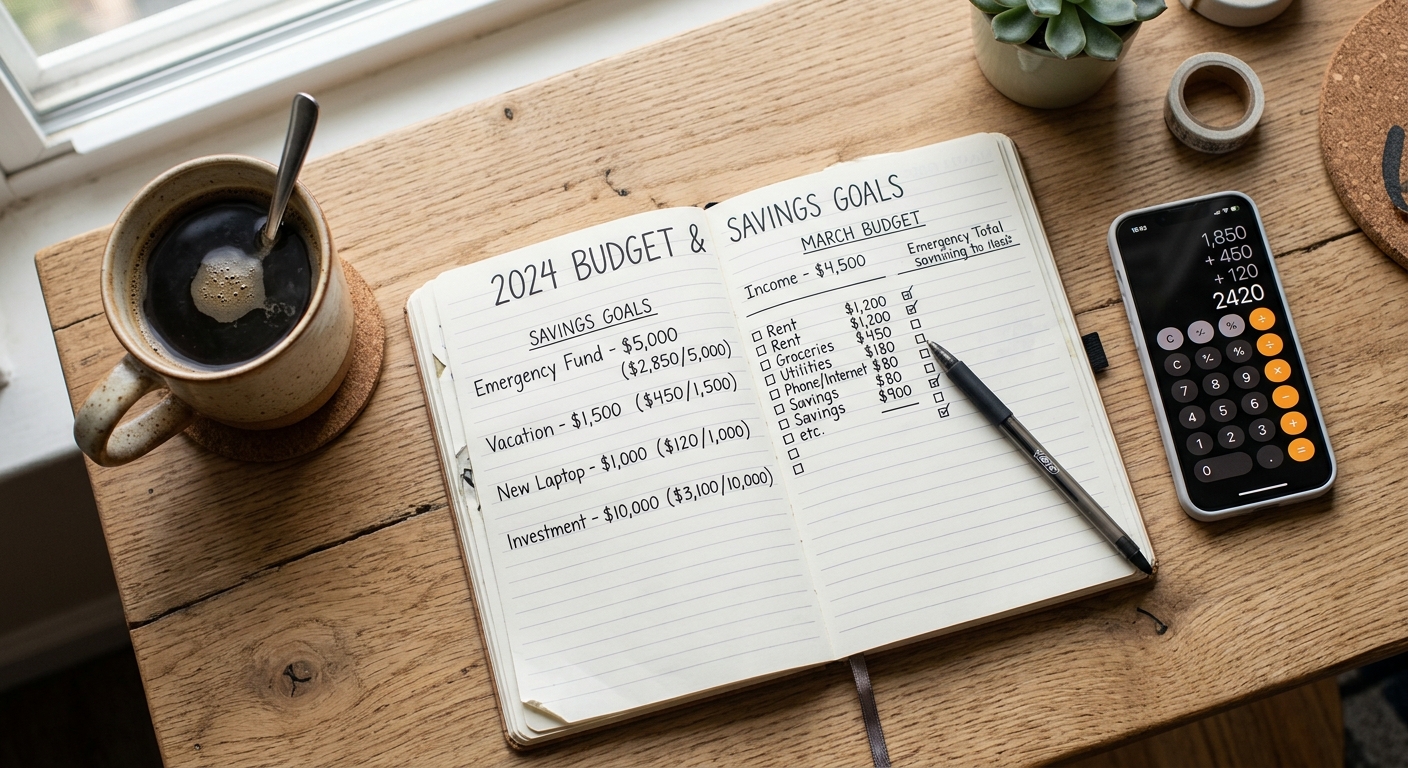
Forget percentages. Start with a dollar amount you will not miss. Maybe that is $25 per deposit. Maybe it is $50. The number matters less than the consistency. Set up an automatic transfer from your checking account to a separate savings account, timed for the day after your VA deposit hits. If disability compensation arrives on the first, the transfer fires on the second. The money moves before you see it in your available balance.
If you are also receiving a GI Bill or VR&E housing stipend during school months, that is where you can accelerate. Take half the stipend and route it straight to savings on the day it deposits. You were surviving on your disability compensation before the stipend started. You can keep surviving on it while the stipend builds your reserves. When the semester ends and the stipend stops, your budget does not change because you were not spending that money on recurring bills.
Windfalls get the same treatment. Tax refunds, back pay from a rating increase, stimulus payments, any lump sum that is not part of your regular monthly cycle goes to the emergency fund until you hit your current rung. After that, you can decide what to do with the next one. But until you have your target, windfalls are not spending money. They are freedom money.
Where to keep the fund and how to protect it
Your emergency fund should be boring. A high-yield savings account at an FDIC-insured bank or credit union. FDIC insurance covers up to $250,000 per depositor, so your money is protected even if the bank fails. That is the whole point. Safe, liquid, accessible in two days or less.
Do not put your emergency fund in a checking account. Checking accounts are for spending, and if the money is right there next to your debit card, you will spend it. A separate savings account, ideally at a different bank from your checking, creates just enough friction to make you think before you withdraw.
Keep a buffer in checking too. One practical approach is to maintain roughly one paycheck worth of padding in your checking account at all times. That cushion absorbs the small timing mismatches between when bills hit and when deposits land, and it keeps you away from overdraft fees. Your checking buffer is not your emergency fund. It is your "I do not want to pay the bank $35 for being two days early on autopay" fund.
Automate everything you can. The transfer to savings should be automatic. Your bills should be on autopay if your income is predictable enough to support it. Every manual transaction is a decision point, and decision points are where plans fall apart. Military OneSource offers free financial counseling for the military community if you want help setting up a system that works for your specific situation.
What counts as a real emergency
This is where people lose their fund. They save $800, then a buddy's wedding comes up and suddenly it is an "emergency." It is not. An emergency is an expense that is both unexpected and necessary. Both conditions.
Your car needs a new alternator so you can get to VA appointments? Emergency. There is a sale on a 65-inch TV? No. A medical bill VA did not cover lands in your mailbox? Emergency. You want a weekend trip because you are burned out? Understandable, but no. That comes out of a different budget line.
The test I use: if I do not pay this right now, what actually happens? If something breaks, someone does not get care, or I lose the ability to earn, it qualifies. If the honest answer is "I will be disappointed," it does not.
Bad planning is also not an emergency. If you knew your car registration was due in March and you did not set money aside, that is a budgeting failure, not an emergency. Your fund should not be subsidizing a budget that does not account for known annual expenses. Make a list of your predictable annual costs (registration, insurance premiums, holiday travel) and divide each by twelve. That monthly amount goes into your regular budget, not your emergency fund.
Keeping the fund alive after you build it
The hardest part is not building the fund. It is not raiding it. Every time you dip into it, you have to refill it. That refill period is when most people give up. They use the fund for a real emergency, see the balance drop, and feel like they are starting over.
You are not starting over. You avoided a payday loan. You avoided an overdraft spiral. You avoided asking family for money. The fund did its job. Now you rebuild it the same way you built it: automatic transfers, stipend routing, and windfalls.
If your benefits situation changes, like a rating increase or a new education benefit starting, revisit your savings rate. More stable income means you can increase the automatic transfer. A higher disability rating means a bigger monthly foundation. Use the increase to move up the ladder faster, not to expand your spending.
The goal is not to have a perfect number in a savings account. The goal is to have enough cash that when something goes wrong, you handle it without debt, without fees, and without panic. On benefit-based income, that cash buffer is the difference between a bad day and a bad year.
Start here
Open a free savings account at an FDIC-insured bank if you do not have one. Set up an automatic transfer for the day after your next VA deposit. Pick a number you can live with, even if it is $25. Write down your first target: $500. That is your rung. Everything else comes after.
Download our emergency fund starter worksheet to map out your income sources, calculate your core monthly expenses, and set your ladder targets. It takes ten minutes and it gives you a plan that is built around your actual numbers, not someone else's advice about saving 20% of a salary you do not have.