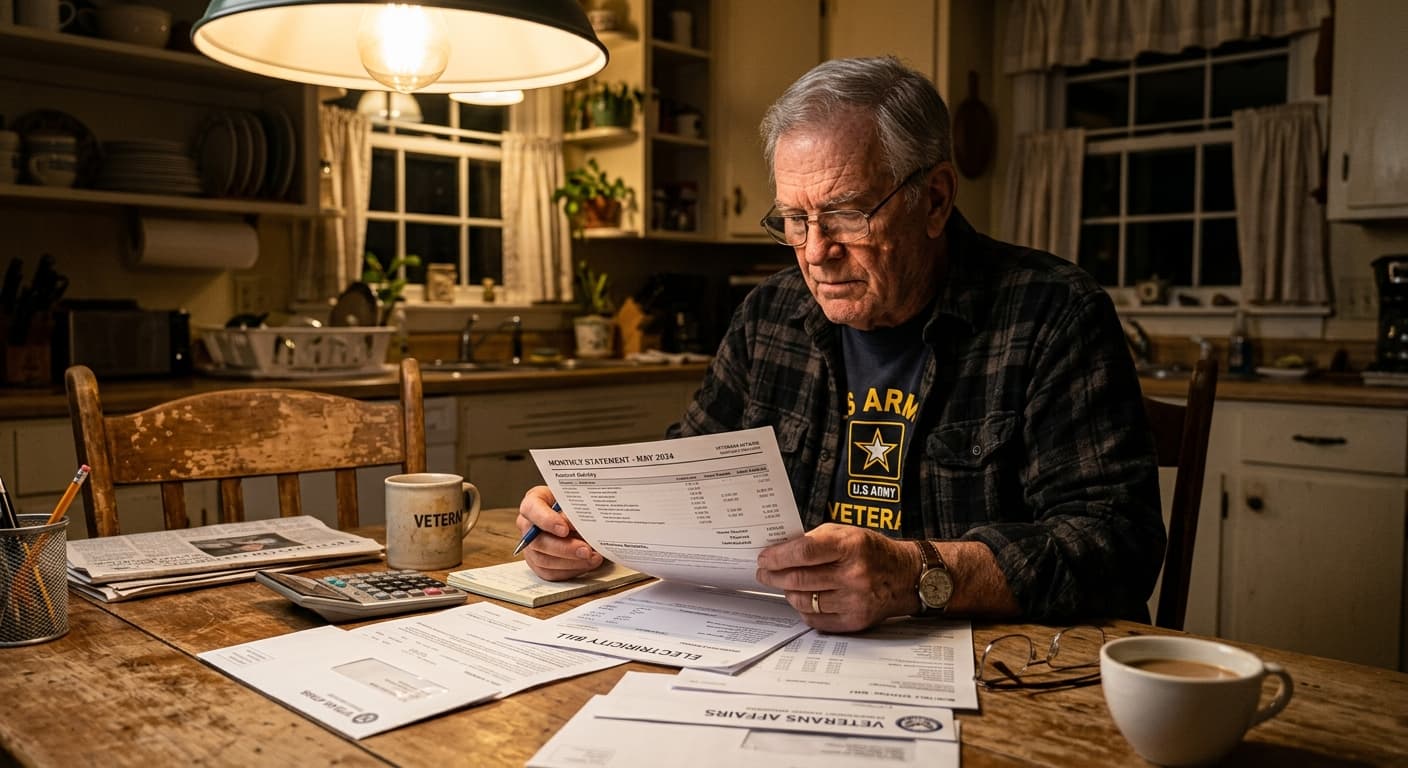
If you are a veteran living on VA disability, pension, or a mix of benefits and part-time work, you already know the math is tight. And when the math is tight, the wrong financial product at the wrong time can put you in a hole that takes years to climb out of.
That is exactly what predatory lenders count on. They do not target veterans because they are bad with money. They target veterans because benefits hit on a predictable schedule, because the transition to civilian income is rough, and because a $400 car repair on the wrong week looks like an emergency that only a fast loan can fix.
This post is about seeing those traps before you step in them, and about building a cash buffer that keeps you out of the payday loan cycle for good.
Why veterans on fixed income get targeted
The VA says it directly: veterans face increasing challenges from predatory marketplace factors, including scams and unsavory business practices targeting military members and veterans. That language comes from the Veterans Benefits Banking Program page, and it is not an exaggeration.
The targeting works because of a few things that are specific to the veteran population:
- Benefits arrive on a set schedule, which makes repayment predictable for lenders. That is a feature for them, not for you.
- The transition from military to civilian life brings changes in income, housing, healthcare, and job security that hit household budgets hard, according to the Association of Personal Financial and Social Counselors (APFSC).
- About 175,000 VA benefit recipients still receive benefits through a Direct Express prepaid card or U.S. Treasury-issued paper check, which can mean higher fees and less protection than a standard bank account.
- Financial stress from transitions, income changes, unexpected expenses, and navigating complex benefit systems creates exactly the kind of pressure where a fast-cash offer sounds reasonable at 10 PM on a Tuesday.
None of that is a character flaw. It is a situation, and situations can be managed if you know what you are dealing with.
The difference between a real short-term cash plan and a debt trap
A real cash plan has a beginning, a middle, and an end. You know the total cost. You know the payoff date. You know what happens if you miss a payment.
A debt trap looks like a solution but works like a subscription you did not agree to. Payday loans can exceed 400% APR. That is not a typo. A $300 loan at that rate, rolled over twice, costs more than the original amount in fees alone. You end up borrowing to repay borrowing, which is the definition of a debt cycle.
Here is a quick gut check: if the product needs you to come back next month to survive, it is not a product. It is a trap.
What the VA Veterans Benefits Banking Program actually offers
The Veterans Benefits Banking Program (VBBP) launched on December 20, 2019, through a partnership between the VA and AMBA. It was designed to help veterans, beneficiaries, caregivers, and survivors open a checking or savings account and enroll in direct deposit.
Here is what VBBP provides that matters for your financial stability:
- Safer direct deposit. VA states that direct deposit is safer and more secure than paper checks. If you are still on a Direct Express card or paper checks, switching to a standard bank account through VBBP removes a layer of fees and risk.
- FDIC or NCUA insurance. Participating VBBP banks are FDIC insured and participating credit unions are NCUA insured. Your money is protected up to legal limits.
- Free financial counseling. Through VeteransBenefitsBanking.org, veterans can sign up for 3 free sessions with an Accredited Financial Counselor. That includes help with customized budgets, debt reduction strategies, credit improvement, and realistic savings goals. The service is free and confidential.
- Financial education through VetCents. VetCents offers education on budgeting, saving, building credit, and homebuying. It is free.
- The Veteran Saves program. An initiative specifically designed to encourage saving habits.
The whole point of VBBP, in the VA's own words, is to help veterans achieve greater financial independence, resiliency, and literacy, and to reduce fraud. If you have not looked into it, start at benefits.va.gov/benefits/banking.asp.
Warning signs of predatory products
You do not need a finance degree to spot these. You need about 30 seconds and a willingness to walk away.
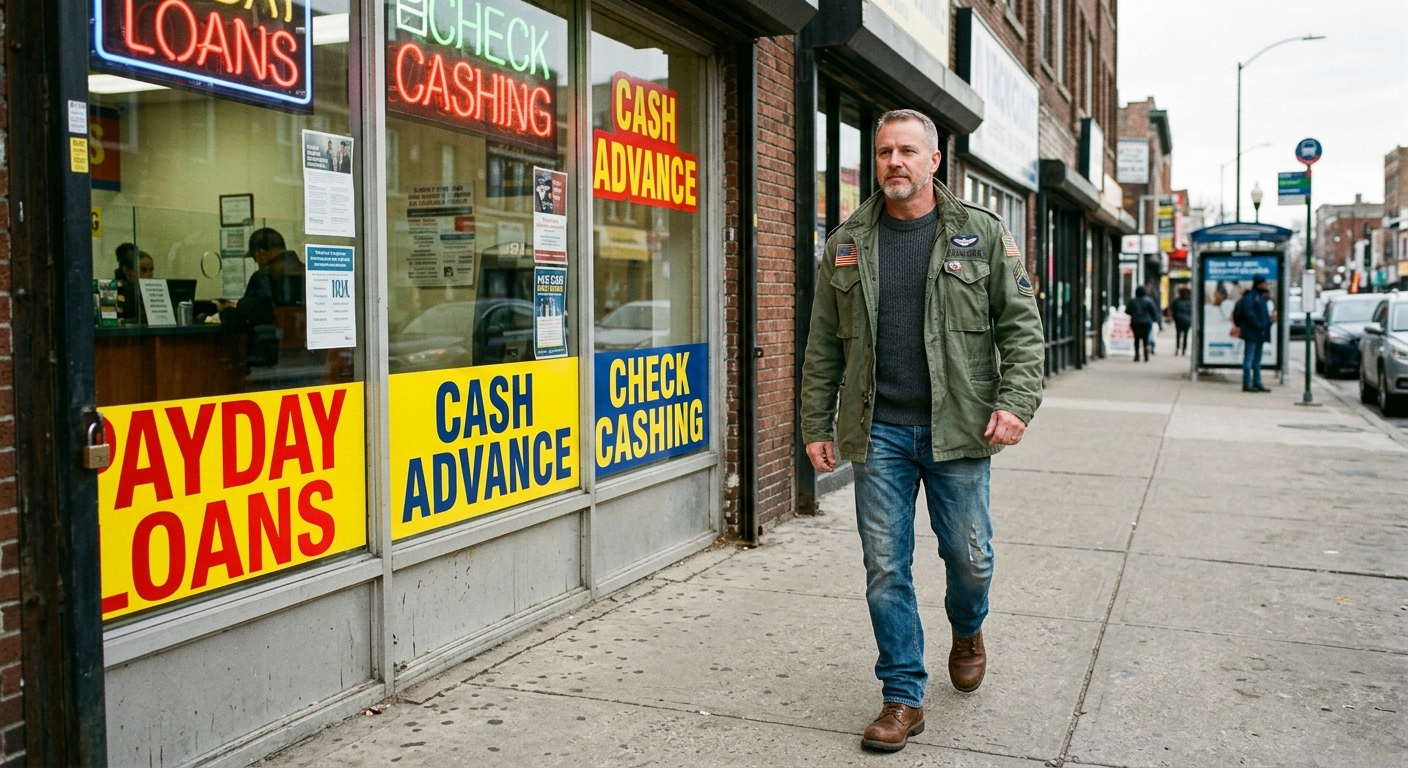
Payday loans. Any loan that requires full repayment on your next pay date, charges triple-digit APR, or markets itself as "no credit check" is a payday loan regardless of what the sign says. These can exceed 400% APR and are built to create repeat borrowers.
Fee-heavy prepaid products. If a prepaid card charges activation fees, monthly fees, transaction fees, and ATM fees, you are paying for the privilege of accessing your own money. A checking account through a VBBP-participating bank or credit union will almost always cost less.
Pressure tactics. "This offer expires today." "You need to decide now." "Just sign here and we will handle the rest." Legitimate financial products do not need you to skip reading the terms. If someone is rushing you, they are counting on you not doing the math.
Unsolicited offers near base or VA facilities. If a lender set up shop near the VA specifically to catch veterans walking out, that tells you something about their business model.
How to build a first cash buffer without wrecking rent, food, or meds
The standard advice is to build 3 to 6 months of living expenses in an emergency fund. That is a fine long-term target. But if you are living check-to-check on VA benefits, telling you to save $6,000 is about as useful as telling you to flap your arms and fly.
Start smaller. The goal is not a perfect emergency fund. The goal is a buffer large enough that a $200 surprise does not send you to a payday lender.
Here is how to get there without cutting things that keep you alive:
- Inventory your debts first. Write down every debt with its balance, interest rate, minimum payment, and due date. You cannot build a buffer if surprise minimum payments keep draining your account.
- Pick one expense to reduce, not eliminate. Cutting your grocery budget by 15% is sustainable. Cutting it in half is not, and you will quit in two weeks.
- Automate a small transfer on benefit deposit day. Even $25 per deposit, moved to a separate savings account the same day benefits hit, builds $300 in a year. That is a real buffer for a real emergency.
- Use the free counseling. Those 3 free sessions through VBBP's financial counseling program exist specifically to help with budgeting, savings practices, expense control, debt management, and credit improvement. A professional looking at your numbers can often find $50 to $100 a month you did not realize you had.
The point is staged progress. You do not need to go from zero to six months of expenses overnight. You need to go from zero to "I can handle a flat tire without borrowing money." Everything after that is momentum.
A practical 30-day stabilization plan
This is a bare-bones plan for the first month. It assumes you are on VA benefits as your primary income and you are starting from a tight position.
Days 1 through 3: Get your numbers on paper.
- List every source of income with exact amounts and dates.
- List every fixed expense: rent, utilities, insurance, medications, food.
- List every debt with balance, rate, minimum payment, and due date.
- Write down what is left. That number is your starting point.
Days 4 through 7: Close the leaks.
- Cancel subscriptions you forgot about or do not use.
- If you are on a Direct Express card or paper checks, start the process of opening a bank account through VBBP. Participating institutions are FDIC or NCUA insured.
- Sign up for a free financial counseling session at VeteransBenefitsBanking.org.
Days 8 through 14: Set the buffer foundation.
- Open a separate savings account if you do not have one. Many VBBP-participating banks offer no-fee savings.
- Set up an automatic transfer of whatever you can afford on the day benefits deposit. Even $10 counts.
- If you have debt above 20% APR, talk to your counselor about a paydown plan. The avalanche method (highest rate first) saves more money. The snowball method (smallest balance first) builds motivation. Either one beats ignoring it.
Days 15 through 30: Hold the line.
- Do not touch the savings for anything that is not a genuine emergency. A genuine emergency is something that threatens your housing, health, or ability to get to work.
- Track your spending for two weeks. You do not need an app. A notebook works.
- At the end of the month, look at what you spent versus what you planned. Adjust. That is it. That is the whole system.
Thirty days will not fix everything. But thirty days of knowing your numbers, having a buffer account, and being connected to free counseling puts you in a fundamentally different position than where you started.
The red-flag checklist and the buffer worksheet
Before we close this out, here is what to take with you.
Predatory loan red flags (if you see two or more, walk away):
- APR above 36%
- Full repayment required on your next pay date
- "No credit check" marketed as a feature
- Fees that are not clearly disclosed before you sign
- Pressure to decide immediately
- Automatic access to your bank account as a loan condition
- The lender is located near a VA facility or military installation and targets veterans specifically
Emergency buffer starter worksheet:
- Monthly income (all sources): $______
- Fixed expenses (rent, utilities, meds, food, insurance): $______
- Debt minimums: $______
- What is left: $______
- Amount to auto-transfer to savings each month: $______ (start with 5 to 10% of what is left)
- Buffer target (enough to cover one surprise expense): $______
- Months to reach target at current savings rate: ______
Fill this out. Put it somewhere you will see it. Update it every month. That single sheet of paper is worth more than any financial product someone tries to sell you at 400% APR.
If you want help working through the numbers, the VBBP financial counseling is free, confidential, and staffed by accredited counselors. Use it. That is what it is there for.