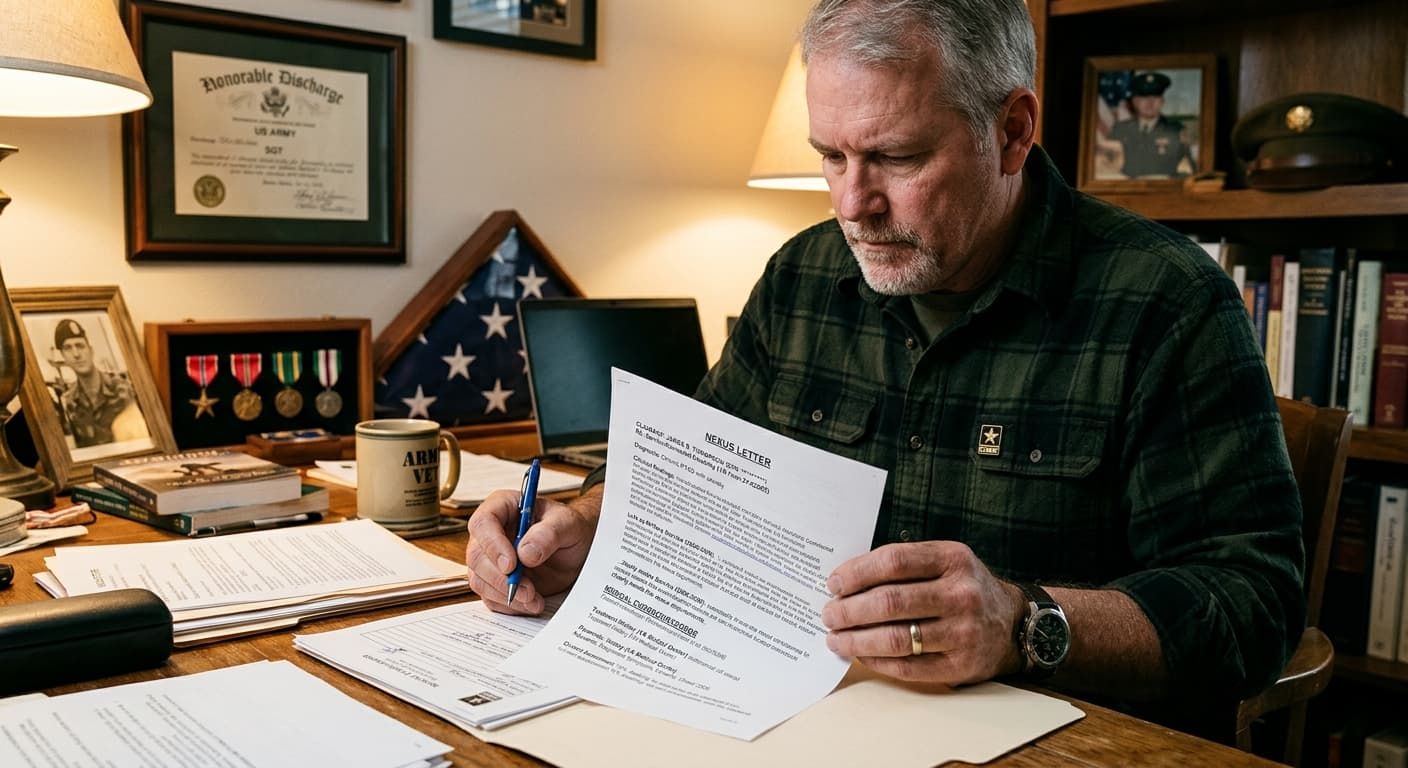
If you came back from service with a skin condition that will not go away, you are not alone. Dermatitis, eczema, fungal infections, burn scars, razor bumps that turned chronic. These conditions are real, they affect your daily life, and the VA has diagnostic codes specifically for them. But skin claims get denied at a rate that does not match how common they are among veterans.
The reason is almost always the same: weak or missing nexus evidence. The condition is documented. The service records show exposure or onset. But there is no medical opinion tying the two together in the language the VA requires. That is where a nexus letter comes in, and that is what this post is about.
Why skin conditions are under-claimed and often denied
Most veterans do not think of skin problems as something worth filing for. You have bigger issues. Your back is messed up, your knees are shot, maybe you are dealing with PTSD. A rash or chronic eczema feels minor compared to all that. So you do not file. Or you file years later when the condition has gotten worse and there is a gap in your treatment records that makes the VA skeptical.
There is also a perception problem. Skin conditions do not look "military" the way a blown-out knee or a TBI does. But the VA rates skin conditions under 38 CFR Section 4.118, Diagnostic Codes 7800 through 7833. There is a whole section of the rating schedule dedicated to this. The ratings go up to 60% for a single skin condition based on how much of your body is affected and what kind of treatment you need.
Here is the General Rating Formula for Skin that the VA uses:
- 60% -- Lesions covering more than 40% of the body, OR continuous systemic therapy like corticosteroids or immunosuppressive drugs or light therapy for the past 12 months
- 30% -- 20 to 40% of the body affected, OR systemic therapy needed for 6 or more weeks but not continuously in the past 12 months
- 10% -- 5 to 20% of the body affected, OR intermittent systemic therapy for less than 6 weeks in the past 12 months
- 0% -- Less than 5% of the body, treated with topical therapy only
Those are real ratings that translate to real monthly compensation. But you do not get there without establishing service connection first. And that requires a nexus.
Common service-connected skin conditions
The VA sees these regularly, and each one has its own path to service connection.
Dermatitis and eczema (DC 7806). This is the big one. It covers a wide range of inflammatory skin conditions and uses the General Rating Formula above. If you developed eczema during service or your service worsened a pre-existing condition, this is your diagnostic code. The key is documenting that it started or got significantly worse while you were in.
Pseudofolliculitis barbae. Razor bumps. If you served, you shaved. If you are Black or have coarse curly hair, you probably dealt with PFB. The military's grooming standards caused or aggravated this for thousands of service members. It is rated under DC 7806 and can get you up to 30%. This is especially common among Gulf War era veterans. Many never filed because they thought razor bumps were "just part of the job." They are a ratable condition.
Chloracne. If you were exposed to Agent Orange or other herbicides containing dioxin, chloracne is on the VA's presumptive list. That means you do not need a nexus letter in the traditional sense. You need to show you served in a location with herbicide exposure and that you have the diagnosis. The VA presumes the connection. If you served in Vietnam, Thailand (certain bases), or handled C-123 aircraft, look into this.
Burn pit related conditions. Veterans who served in Iraq and Afghanistan were exposed to burn pits that incinerated everything from medical waste to electronics to human waste. The PACT Act expanded presumptive conditions for burn pit exposure, and skin conditions are among them. If you have a skin condition that started during or after deployment to a burn pit location, file for it.
Dermatophytosis (DC 7813). Fungal infections. Jungles, deserts, communal showers, boots that never fully dry out. Service creates the perfect conditions for fungal skin infections that become chronic. These are rated under the same General Rating Formula.
Psoriasis (DC 7816). Stress is a known trigger for psoriasis. If yours first appeared during service or got measurably worse during a deployment, that is a service connection argument.
Scarring (DC 7800-7805). Burns, lacerations, surgical scars from service-related injuries. These have their own separate diagnostic codes and rating criteria based on location, size, and whether they are painful, unstable, or limit function.
What a nexus letter needs to say
Under 38 CFR 3.303, service connection requires three things: evidence of a current disability, evidence of an in-service event or injury or disease, and a nexus between the two. A nexus letter is the document that provides that third element. It is a medical opinion written by a qualified healthcare provider that explicitly connects your current condition to your military service.
The magic phrase is "at least as likely as not." That means the provider believes there is a 50% or greater probability that the condition is related to service. Not "possibly related." Not "could be connected." Not "may have been caused by." Those weaker phrases will get your letter dismissed. The VA's standard is "at least as likely as not," and your letter needs to use that exact language or something equally definitive.
This matters because the VA operates under the "benefit of the doubt" doctrine from 38 USC 5107(b). If the evidence is in approximate balance, meaning roughly 50/50, the decision goes in your favor. A nexus letter that hits that threshold puts you on the right side of that doctrine.
Every nexus letter needs three essential elements:
1. A current diagnosis. The provider must state your specific diagnosed condition. "Chronic dermatitis affecting the bilateral forearms and chest" is good. "Skin problems" is not. The diagnosis should map to a VA diagnostic code when possible.
2. Identification of the in-service event or exposure. This is where your provider references your service treatment records, your military occupational specialty, your deployment locations, or specific incidents. "The veteran served as an infantry soldier in Afghanistan from 2009 to 2010, where he was exposed to burn pit emissions at FOB Salerno on a daily basis for 11 months." Specific. Verifiable. Tied to your records.
3. The medical connection with probability language. This is the nexus itself. The provider explains, based on their medical expertise and review of your records, why the condition is connected to service. "It is my professional medical opinion that the veteran's chronic dermatitis is at least as likely as not caused by his documented exposure to burn pit emissions during his deployment in Afghanistan. The onset of symptoms within 18 months of exposure, the chronic and recurrent nature of the condition, and the absence of alternative etiological factors support this conclusion."
That is what a nexus letter looks like when it works. Notice it does not just state an opinion. It explains the reasoning. VA raters and C&P examiners weigh opinions based on the rationale provided. A one-sentence opinion with no reasoning carries almost no weight. A detailed explanation with citations to your records and medical literature carries a lot.
Finding a provider willing to write one
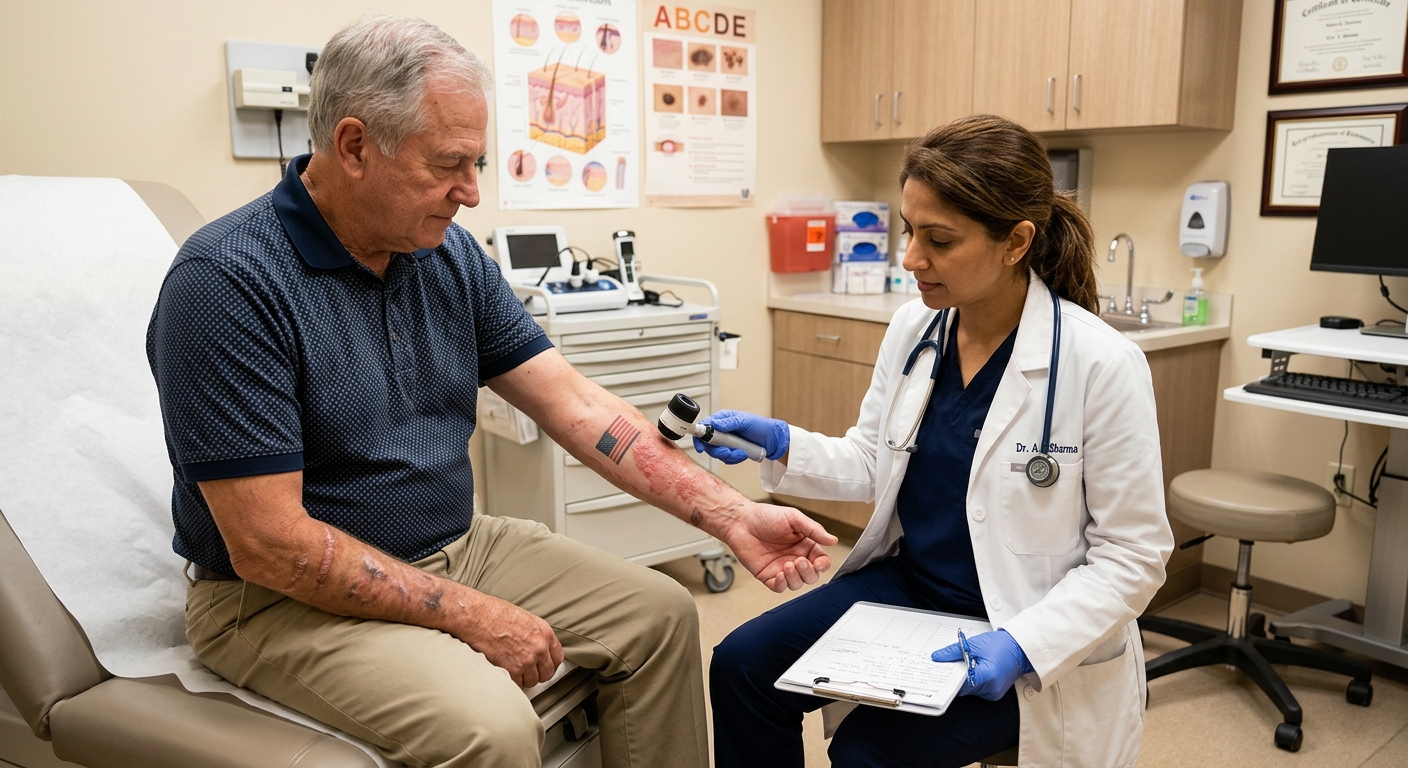
This is where a lot of veterans get stuck. You ask your VA primary care doctor for a nexus letter and they say they cannot do it, or they write something so vague it is useless. VA doctors are often hesitant to write nexus letters because they feel it puts them in an advocacy role rather than a clinical one. Some VA facilities have internal policies discouraging it. That is frustrating, but it is reality.
Your options:
Private physicians. Any licensed healthcare provider can write a nexus letter. Your private dermatologist, your primary care doctor outside the VA, a specialist who has treated your condition. The provider needs to be qualified to evaluate your specific condition. A dermatologist writing about a skin condition carries more weight than a general practitioner, though a GP can still write an effective letter for most conditions.
Independent medical opinion services. There are companies that connect veterans with doctors who specialize in writing nexus letters. These providers review your records, conduct an examination (often via telehealth), and produce a nexus letter. They typically charge between $500 and $1,500 per letter. The good ones produce detailed, well-reasoned letters. The bad ones produce cookie-cutter templates that raters see through immediately. Ask for sample letters before paying. Look for providers who are familiar with the VA rating schedule and the specific diagnostic codes for your condition.
Your VSO. Some Veterans Service Organizations have relationships with medical providers who do nexus letters. Ask your VSO representative. They may be able to connect you with someone who has a track record of producing letters that result in favorable decisions.
Whoever writes the letter needs access to your service treatment records and your post-service medical records. Do not expect a provider to write a credible nexus letter based only on a conversation. The letter's strength comes from the documented record, not from your verbal account alone.
Strengthening a weak nexus letter
Maybe you already have a nexus letter and it did not work. Or maybe you have one and you are not sure if it is strong enough. Here is how to evaluate it and make it better.
Check the probability language. If the letter says "possible," "might be," "could be," or "cannot rule out," it is too weak. The VA standard is "at least as likely as not" (50% or greater). If your letter does not hit that threshold, ask the provider to revise it. Explain the specific language the VA requires. Most providers are willing to adjust if they genuinely believe the connection exists.
Check for a rationale. A letter that says "In my opinion, this condition is at least as likely as not related to service" with no explanation is a bare conclusion. Raters give these minimal weight. The letter needs to explain WHY. What in the service records supports the connection? What is the medical mechanism? Why are alternative causes less likely? The rationale is what separates a persuasive opinion from a worthless one.
Check that it references your actual records. A generic letter that could apply to any veteran is a red flag. The letter should cite specific entries from your service treatment records, specific dates, specific deployments, specific exposures. If your provider did not review your records, the letter is built on sand.
Check the provider's credentials. The letter should identify who wrote it, their medical license, their specialty, and their qualifications to opine on your specific condition. A board-certified dermatologist writing about eczema carries more weight than a physician assistant. That does not mean a PA cannot write an effective letter, but credentials matter in how the VA weighs the opinion.
Add supporting evidence. A nexus letter works best as part of a complete evidence package. Buddy statements from fellow service members who can confirm your exposure or when your condition first appeared. Service treatment records showing complaints or treatment. Post-service treatment records showing continuity. Photographs of your condition over time. Published medical literature linking your type of exposure to your type of condition. The more the nexus letter can reference, the stronger it becomes.
Remember that C&P exams often last only 15 to 30 minutes and focus primarily on rating severity rather than establishing service connection. The examiner may not dig deep into whether your condition is connected to service. That is why the nexus letter matters so much. It does the work that a short C&P exam cannot.
Nexus letter quality checklist
Before you submit your claim, run your nexus letter through this checklist. Every item should be a yes.
- Does it state a specific diagnosis that maps to a VA diagnostic code?
- Does it identify the in-service event, exposure, or condition that caused or aggravated the skin condition?
- Does it use the phrase "at least as likely as not" or equivalent 50%+ probability language?
- Does it explain the medical reasoning connecting service to the current condition?
- Does it reference your specific service treatment records and post-service medical records?
- Does it address and rule out alternative causes?
- Does it include the provider's full credentials, license number, and specialty?
- Is the provider qualified to opine on your specific type of skin condition?
- Does it describe the chronology (when symptoms started, how they progressed)?
- Is it supported by buddy statements, treatment records, or medical literature?
If any answer is no, fix it before you file. A weak nexus letter is not just unhelpful. It can actively hurt your claim if a C&P examiner reviews it and writes a negative opinion that specifically counters it. Get it right the first time.
You can use Command to walk through your specific skin condition, understand which diagnostic code applies, and figure out what your nexus letter needs to address. It is built for exactly this kind of thing. And if you have questions about your claim or want to gut-check your evidence package, ask Command. Real answers, no upsell, no runaround.