Most veterans know the basics of VA benefits. Disability ratings. GI Bill. Home loans. Maybe a few of you have figured out the VR&E program. But financial literacy? The stuff that keeps you from getting wrecked by a payday lender at your third duty station, or from buying a house you cannot actually afford when you get out? That has mostly been figured out on your own, or not at all.
That might finally be changing.
The Military Financial Literacy Act, a bipartisan bill introduced in March 2026 by Representative Kristen McDonald Rivet of Michigan and Representative Pat Harrigan of North Carolina, would fundamentally reshape how the Department of Defense approaches money education for service members and veterans. It is not a minor regulatory tweak. If it passes into law, DOD would be required to partner with HUD-approved, military-specialized nonprofit counseling organizations to deliver one-on-one financial and housing counseling to every active-duty and transitioning service member in the country.
Most veterans have not heard about this yet. They will.
What the bill actually does
The Military Financial Literacy Act does not just tell service members to read a pamphlet about compound interest. It mandates structured, one-on-one counseling through organizations that understand the specific pressures of military life. These are HUD-approved nonprofits that have experience with military clients, which matters because the financial problems service members face are not generic.
Here is what the counseling would cover:
- Budgeting that accounts for PCS moves, deployment pay fluctuations, and the transition from military to civilian income
- Predatory lending recognition so service members can spot payday loans, title loans, and high-APR credit offers before they sign
- Housing decisions related to PCS orders because signing a two-year lease when you might get orders to Fort Bragg next month is a different problem than normal renting
- VA home loans and what they actually mean for long-term financial health, including the assistance available through VA housing grants
This did not come out of nowhere. The April 2025 GAO report on DOD financial literacy training identified significant gaps in how the military currently delivers money education. The current system was not working. Organizations representing millions of veterans, including the VFW, VAREP, and Vietnam Veterans of America, supported this bill precisely because they see the consequences of those gaps every day.
Why veterans are easy targets
Representative Pat Harrigan has said it directly: service members are easy targets. That is not an insult to veterans. It is an observation about the structural reality of military life.
You move constantly. Every PCS move disrupts your housing, your local credit relationships, your established banking. You are navigating VA benefits, housing markets, and lenders, often while recovering from injuries, managing PTSD, or just trying to hold your family together through another transition. That is a lot of complexity to handle without financial guidance.
And lenders know it. Rep. Harrigan has described the situation in stark terms: service members face "lenders potentially with ill intent" who understand the military's unique financial structure better than most service members do. When you are at your third duty station in six years, trying to buy a car before you PCS again, and some finance guy at the dealership is running calculations on a loan with 22% APR because you have "thin credit," that is not a fair fight.
Joy Craig, VFW national legislative service associate director, put it plainly: financial readiness is a critical component of overall military readiness and long-term veteran success. The VFW does not say things like that casually. They see the veterans who did not get that counseling. They see the ones who are three months behind on payments because a predatory loan caught them at a vulnerable moment. They see the ones who bought houses they could not afford because nobody explained what the VA loan actually required them to qualify for.
This bill is about closing that gap before it destroys another veteran's finances.
The housing piece is especially important
Service members are uniquely exposed to housing market volatility in ways that civilian financial advice does not prepare them for. You do not choose when you move. You do not choose where you go. You get PCS orders and you have to make housing decisions under time pressure, often in a market you have never lived in, with limited local knowledge.
For veterans using VA home loans, the temptation is to treat the loan guarantee as a blank check. It is not. The VA guarantees the loan, but you are the one making the payments. A house that makes sense at Fort Benning does not make sense three years later when you get orders to Drum. And if you are getting out entirely, the transition from BAH to civilian income is a shock that many veterans are not prepared for.
VA housing grants exist specifically to help veterans with disabilities and their families access housing modifications, adapted housing, and specialized assistance. If you have a service-connected disability rating and you have not looked into what the VA offers through its housing grant programs, you are leaving money on the table. Specially Adapted Housing (SAH) grants and Special Housing Adaptation (SHA) grants can cover substantial modification costs for eligible veterans. These are not loans. They do not need to be repaid.
The counseling this bill would require includes exactly this kind of guidance, which means veterans would actually know these programs exist before they make housing decisions that follow them for thirty years.
What you can do right now
You do not have to wait for legislation to get this help. Free and low-cost veteran financial resources already exist. Using them before you are in crisis is the move.
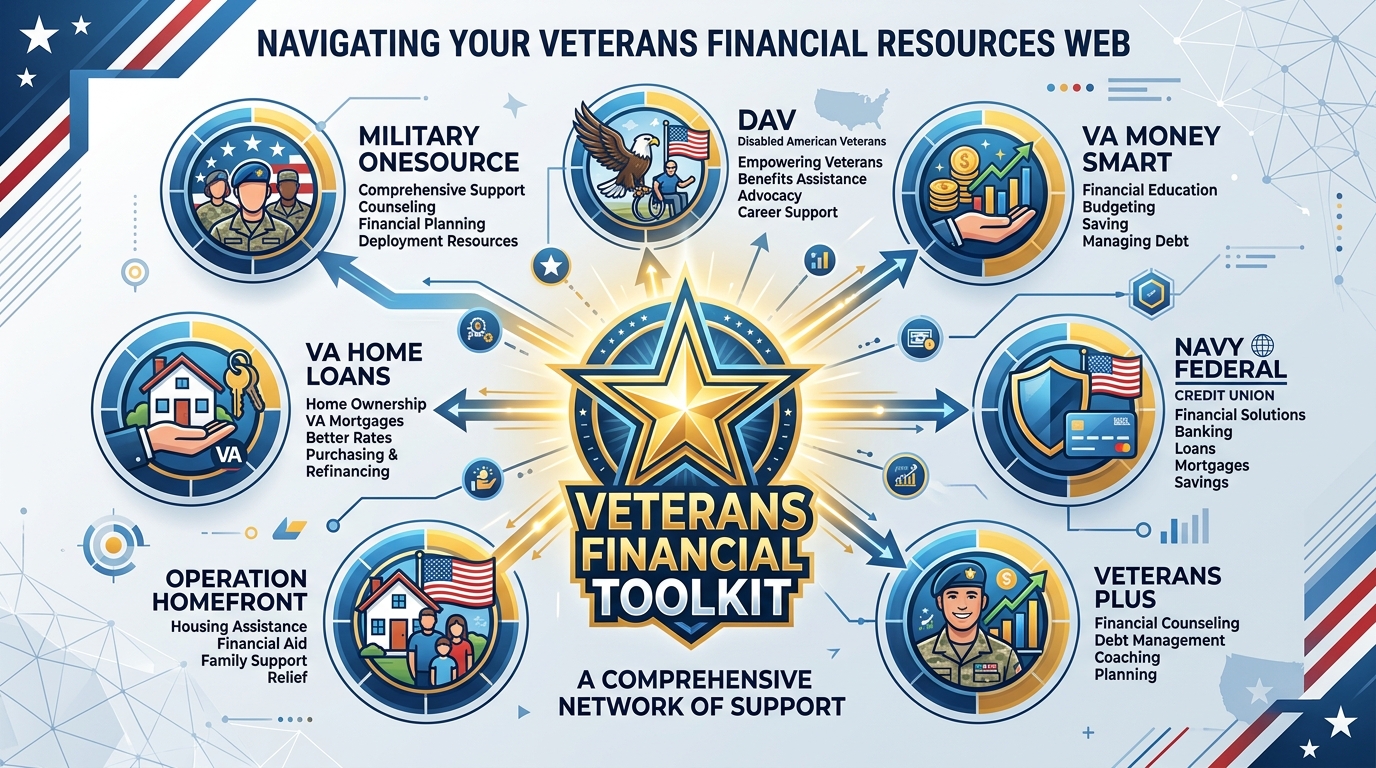
Military OneSource is a DOD program available to active-duty, National Guard, and reserve service members and their families. It includes financial counseling, tax services, and specialty consultations at no cost. You have already paid for it through your service. Use it.
DAV workshops run through the Disabled American Veterans organization, which has over 1 million members and more than 1,200 local chapters across the country. DAV's certified benefits advocates help veterans navigate the VA system, understand their ratings, and plan financially for what comes next. The workshops are free. The expertise is real.
VA's Money Smart is a financial education program specifically designed for veterans and service members. It covers budgeting, credit, debt management, and homeownership. It is not a replacement for one-on-one counseling, but it is a solid starting point.
Navy Federal Credit Union has built its entire reputation around serving veterans and military families. If you are still using a predatory checking account that charges you $10 a month to not manage your money, Navy Federal is an immediate upgrade that costs you nothing to open.
VeteransPlus offers debt management plans and financial counseling tailored specifically to veterans on fixed incomes. If you are already in a debt cycle, they can help you structure a way out without the credit counseling industry markup.
Operation Homefront provides emergency financial assistance to military families facing short-term crises. If you are behind on a bill because of an unexpected PCS or a medical issue, they may be able to help before the situation becomes catastrophic.
The bigger picture
Here is the honest reality. Veterans on 100% disability can receive over $3,600 per month in VA compensation in 2026. That is not poverty. That is not barely surviving. That is a foundation that, if managed correctly, can support a real life. The problem is not the amount. The problem is that nobody taught most veterans how to manage it, and the financial services industry is structured to exploit exactly that knowledge gap.
This bill is not a cure-all. Legislation does not equal implementation, and DOD has a long track record of underdelivering on mandated support programs. But the fact that VFW, VAREP, and Vietnam Veterans of America are all aligned on this tells you something. The veterans organizations that have been fighting for your benefits for decades see this as a real opportunity, not a checkbox exercise.
In the meantime, the resources are already there. Download the Veterans Financial Planning Checklist and start working through it before you are sitting across from a lender who has done this a thousand times and you have done it never.