
Here is the thing nobody tells you at your TAP briefing: your education benefits are powerful, but they are not simple, and misusing them costs real money. Veterans making the jump into tech often pick the wrong benefit first, miss housing gaps they did not plan for, and burn months of entitlement on programs that could have been covered a different way.
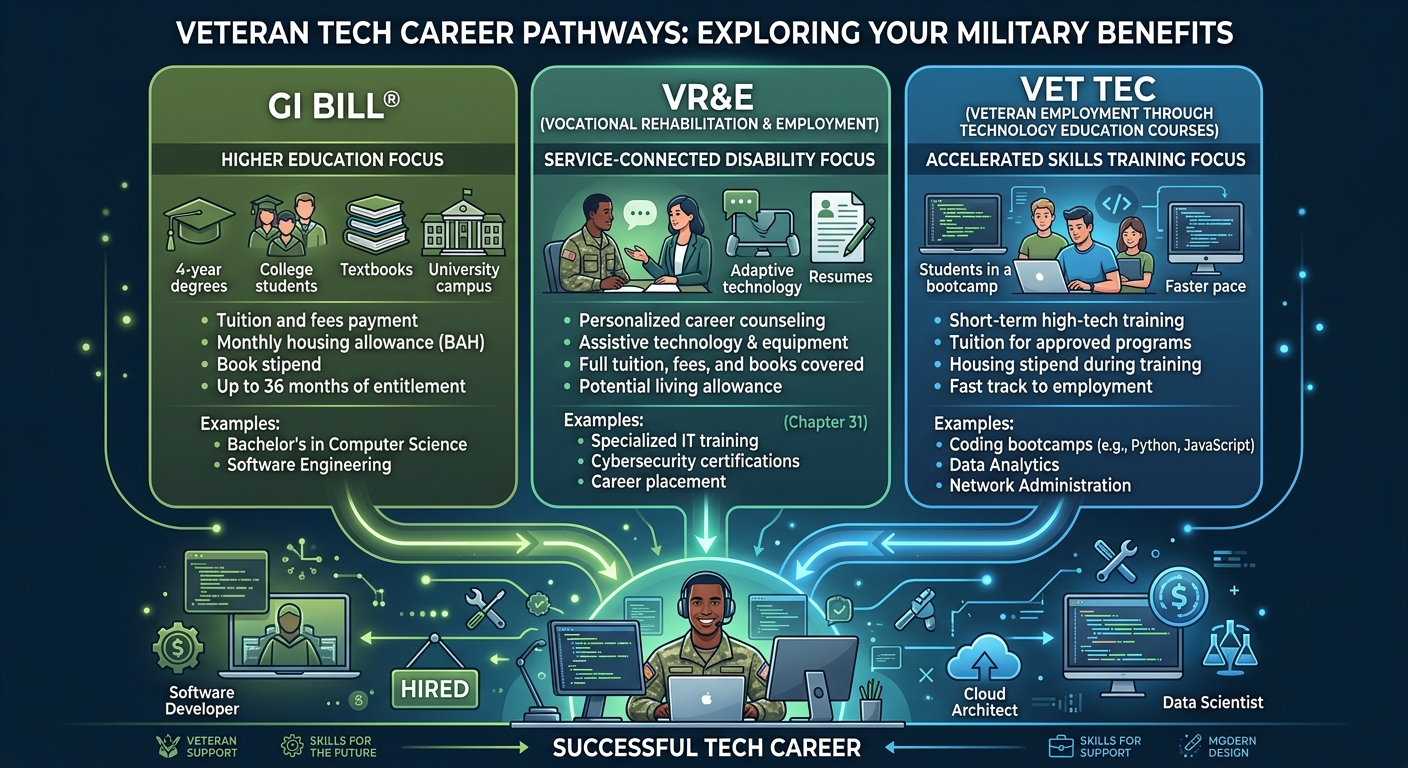
This post is a practical guide to stacking VR&E (Chapter 31), the Post-9/11 GI Bill (Chapter 33), and the new VET TEC 2.0 program so you can get into tech without wrecking your cash flow.
Why the Transition Gets Financially Messy Fast
Most veterans do not go broke paying tuition. They go broke in the gaps. The housing allowance stops between semesters. A boot camp takes longer than expected and the benefit runs short. They pick one program when a different benefit would have covered the same training and preserved entitlement for later.
The financial mess usually comes from three places:
- Picking the wrong benefit first — using GI Bill months on something VR&E would have covered without touching your entitlement.
- Housing payment gaps — VA does not pay Monthly Housing Allowance during school breaks, including between semesters, quarters, and terms. That gap hits hard if you are not prepared.
- Entitlement math mistakes — not understanding that some programs charge entitlement and others do not, or that stacking rules have changed.
A tech transition is a 12- to 24-month project. If you do not map your benefits to a timeline with a budget underneath it, you are going to feel the squeeze.
When VR&E Should Beat the GI Bill for a Tech Pivot
VR&E (Vocational Rehabilitation and Employment, Chapter 31) is built for veterans with service-connected disabilities who need training to move into sustainable employment. If that describes your situation, VR&E should be your first conversation — not the GI Bill.
Here is why:
- Eligibility is broad. You can apply if you have a VA service-connected disability rating of at least 10% and your discharge was not dishonorable. If you separated on or after January 1, 2013, there is no 12-year time limit on eligibility.
- It does not burn your GI Bill. Using VR&E does not deduct entitlement from other VA education benefits like the Post-9/11 GI Bill or the Montgomery GI Bill. That is a massive deal — it means you can use VR&E for your tech training and keep your GI Bill months intact for something else down the road.
- The services go beyond tuition. VR&E can cover evaluation, counseling, job training, resume and work-readiness support, help finding and keeping a job, on-the-job training, apprenticeships, non-paid work experience, and post-secondary education.
- You might get the higher housing rate anyway. If you have at least 1 day of Post-9/11 GI Bill entitlement remaining and you are within your GI Bill eligibility period, you can elect to receive the Post-9/11 GI Bill subsistence rate instead of the standard Chapter 31 rate. VA says in most cases the GI Bill rate is higher.
The bottom line: if you qualify for VR&E, use it first. You get training, support services, and potentially the higher housing rate — all without spending a single day of GI Bill entitlement.
What the Post-9/11 GI Bill Still Does Best
The Post-9/11 GI Bill is the benefit most veterans know, and for good reason. It is flexible, well-funded, and covers a wide range of programs.
Key strengths for a tech transition:
- Tuition and fees paid directly to the school.
- Monthly Housing Allowance when enrolled more than half time — pegged to E-5 BAH rates for your campus ZIP code.
- Books and supplies stipend.
- Licensing and certification tests — the GI Bill covers national exams, licensing tests, certification tests, and preparatory courses.
- No expiration if your service ended on or after January 1, 2013, thanks to the Forever GI Bill.
One important update: under the Rudisill decision, if you have two or more qualifying periods of active duty and are eligible for both the Post-9/11 GI Bill and MGIB-AD, you may qualify for up to 48 months of combined benefits. If your last education claim decision was on or after August 15, 2018, VA should automatically review your entitlement. If it was before that date, you may need to file VA Form 22-1995.
Where the GI Bill fits best in a tech pivot: degree programs at accredited universities, longer certificate programs, or situations where you need the housing allowance to be your primary income for an extended period. Save it for the big-ticket, long-duration training — not the short boot camp that VR&E or VET TEC could handle.
One thing to watch: a recent VA policy advisory clarified that preparatory courses for licensure or certification tests are distinct from programs of education. Payment for prep courses is limited to reimbursement of tuition and mandatory fees only — they do not confer Monthly Housing Allowance. Plan accordingly if you are counting on housing money while studying for a cert.
What VET TEC 2.0 Can and Cannot Do in 2026
VET TEC 2.0 is the updated version of the original VET TEC program, designed specifically to help veterans and active-duty service members develop skills in high-tech industries. It covers computer programming, computer software, data processing, information sciences, and media application.
What it covers:
- Tuition and fees paid to the training provider.
- Money for housing during training.
- Books and supplies.
Eligibility requirements (these are different from the original VET TEC):
- Discharge other than dishonorable, or active-duty and within 180 days of separation.
- At least 36 months on active duty.
- Under age 62 when approved.
The entitlement trade-off: If you have remaining entitlement under DEA, MGIB-AD, or the Post-9/11 GI Bill, VA charges 1 month of entitlement for every 1 month of full-time VET TEC 2.0 training. However — and this is the key part — if you have zero remaining entitlement, you can still participate even if you have already used the maximum 48 months of VA education benefits.
What to know right now: As of the most recent VA update in March 2026, the VET TEC 2.0 application is not available yet. VA says to check back in June. The program is also limited to 4,000 paid participants per fiscal year, though Congress may adjust that number. Plan your timeline around that reality — do not count on getting a slot the day the application drops.
Like the GI Bill, you need to verify enrollment every month to keep your housing allowance flowing.
Budget Traps Veterans Miss
Here are the specific financial traps that catch veterans mid-transition:
The housing gap between terms. VA does not pay Monthly Housing Allowance during school breaks. If you are on the Post-9/11 GI Bill or VET TEC 2.0 and your program has a three-week break between semesters, that is three weeks with no housing payment. For a veteran whose MHA is their primary income, that gap can mean a missed rent payment. Build a buffer or pick programs with minimal breaks.
Enrollment verification lapses. Both the Post-9/11 GI Bill and VET TEC 2.0 require monthly enrollment verification to keep your housing allowance and any kicker payments coming. Miss a verification and your payment stops. Set a recurring reminder on the first of every month.
Using GI Bill months when VR&E would have worked. Every month of GI Bill entitlement you spend on training that VR&E would have covered is a month you cannot get back. VR&E does not deduct from your GI Bill. If you qualify for both, the math is clear.
VET TEC 2.0 entitlement charges. If you still have GI Bill or MGIB months remaining, VET TEC 2.0 charges against that entitlement — one month for one month of full-time training. That is fine if you plan for it. It is a problem if you assumed VET TEC was free and then find your GI Bill balance shorter than expected.
Cert prep without housing allowance. If you are taking a preparatory course for a licensure or certification test under the GI Bill, be aware that those courses only reimburse tuition and mandatory fees. No Monthly Housing Allowance. Budget for living expenses out of pocket during that stretch.
A Practical Benefits-Stacking Plan for a Veteran Moving Into Tech
Here is a realistic sequence for a veteran with a 10%+ disability rating, Post-9/11 GI Bill eligibility, and an interest in software development or cybersecurity:
Phase 1 — VR&E for foundational training.
- Apply for VR&E. With a 10%+ service-connected rating and a non-dishonorable discharge, you meet the baseline eligibility.
- Work with your VR&E counselor to get approved for a tech training track — this could be a coding boot camp, a certificate program, or even a degree program.
- Elect the Post-9/11 GI Bill subsistence rate if you have at least 1 day of GI Bill entitlement remaining. You keep the higher housing rate without spending GI Bill months.
- Take advantage of VR&E's full service package: resume support, job placement, work-readiness coaching. These are included and they matter.
Phase 2 — VET TEC 2.0 for specialized skill-building (when available).
- Once VET TEC 2.0 applications open, apply early. With only 4,000 slots per fiscal year, waiting is a risk.
- Use VET TEC 2.0 for a focused, short-duration program — a specific coding boot camp, a data science intensive, or a cybersecurity skills course.
- If you still have GI Bill entitlement, know that VET TEC 2.0 will charge against it. Factor that into your remaining-months math.
- If you have already exhausted your entitlement, VET TEC 2.0 is still available to you. That is one of its strongest features.
Phase 3 — Post-9/11 GI Bill for the long play.
- If you need a full degree — a B.S. in Computer Science, a cybersecurity master's — this is where the GI Bill earns its keep.
- Check your Rudisill eligibility. If you have two qualifying periods of active duty, you may have up to 48 months of combined benefits instead of 36.
- Budget for breaks between semesters. No MHA during those gaps. Build a one-month emergency cushion for every expected break.
- Use the licensing and certification test benefit to knock out industry certs (CompTIA, AWS, CISSP) — but remember, prep course reimbursement does not include housing allowance.
Throughout all phases:
- Verify enrollment every single month. No exceptions.
- Track your remaining entitlement in a spreadsheet. Know exactly how many months you have left under each benefit.
- Keep a minimum one-month living expense buffer for housing gaps.
- If VA retroactively approves previous months under VR&E, they may restore entitlement to another education program. Stay in contact with your counselor.
Build Your Tech Transition Budget
Knowing which benefits exist is step one. Mapping them to your actual timeline, living expenses, and career goals is step two — and that is where most veterans stall out.
We built a Tech Transition Budget Planner + Benefits Stack Worksheet to help you lay it all out. It walks you through your benefit eligibility, training timeline, monthly housing math, gap months, and entitlement tracking so you can see the full picture before you commit to a program.
Stop guessing. Start planning. Your benefits are worth too much to leave to chance.