
In 2026, AI tools are handling work that used to fill entire job descriptions. Junior data analysts who once spent weeks cleaning spreadsheets now watch an LLM do it in minutes. Entry-level copywriters compete with models that produce passable marketing copy on demand. Customer service teams are shrinking as chatbots handle tier-one tickets without human intervention. According to McKinsey's 2025 workforce report, roughly 30% of tasks in entry-level knowledge work are now partially or fully automated.
That sounds alarming if you're planning a career transition. But here's the thing: automation is mostly eating the repetitive, procedural parts of jobs. The work that requires judgment calls under incomplete information, the ability to coordinate people across teams, and the willingness to own outcomes when things go sideways? That work is growing. And veterans have been doing it for years.
The goal of this guide is to get specific. Which career lanes actually reward veteran experience? What do those roles look like day-to-day? What do they pay? And how do you get from DD-214 to offer letter in about 60 days?
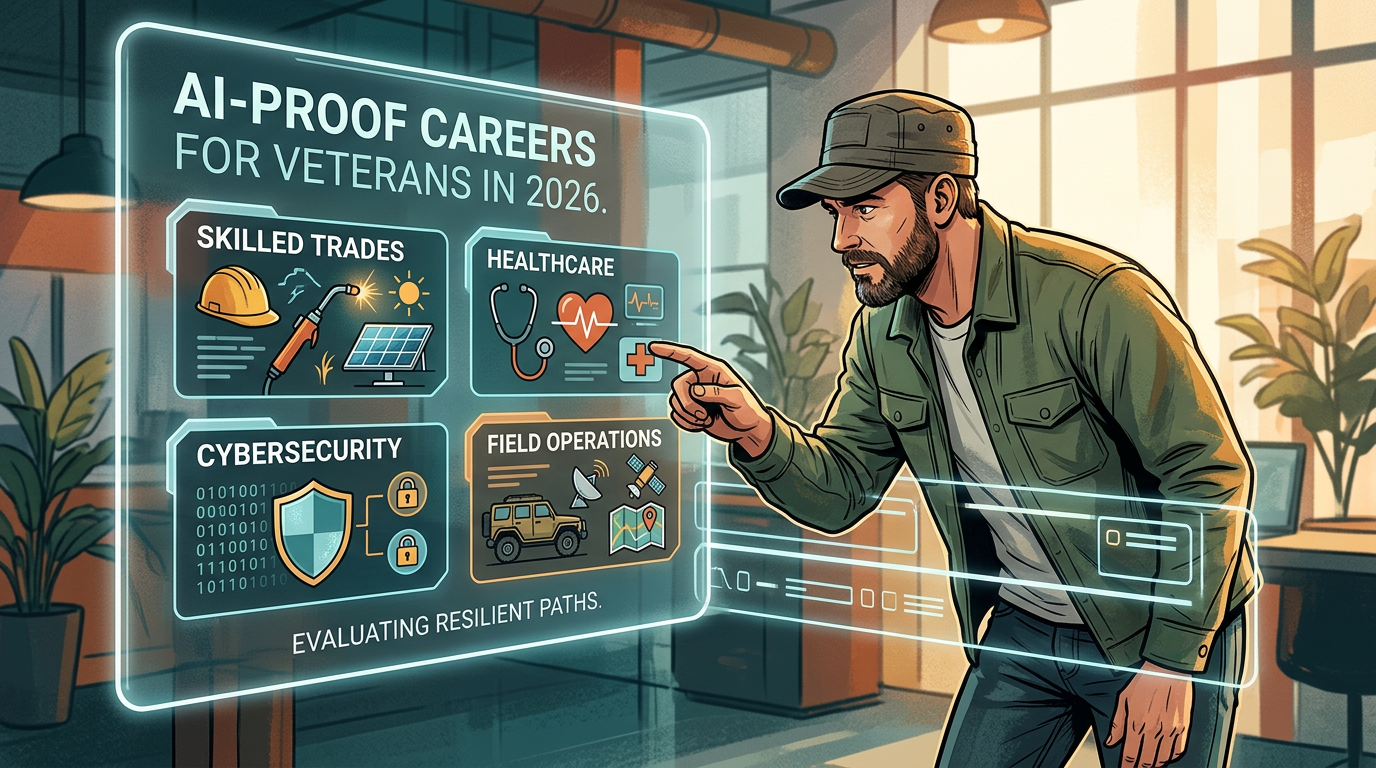
Why Veteran Skills Are Getting More Valuable
Think about what an infantry platoon leader actually does. They take ambiguous orders, translate them into a plan their team can execute, coordinate across multiple elements, adjust when contact happens, and write the report after. That sequence (take ambiguity, create structure, execute under pressure, own the result) is exactly what companies struggle to hire for in 2026.
A logistics NCO who managed supply chains across multiple FOBs in Afghanistan was doing program operations before they knew the term existed. A signals intelligence analyst who correlated intercepts with ground truth was doing data analysis with consequences. A military police investigator who ran cases from intake through prosecution was doing compliance and risk work.
The problem is that most veterans describe this experience in military language on their resumes, and hiring managers in the private sector don't know what a "battle captain" does. The translation gap is real, but it's solvable.
Career Lane 1: Program and Product Operations
Program ops and product ops roles exist because companies ship complex products that require coordination across engineering, design, sales, legal, and support teams. Someone has to make sure all of those groups are aligned, that timelines hold, that blockers get escalated, and that stakeholders get accurate status updates. AI can summarize meeting notes and generate status reports, but it can't run a cross-functional standup, make a prioritization call when two teams disagree, or hold a vendor accountable for a missed deliverable.
Day-to-day, a program operations manager might spend their morning reviewing sprint progress across four engineering teams, their midday in a stakeholder review with the VP of Product, and their afternoon unblocking a procurement issue that's holding up a launch. It's meeting-heavy work, but the meetings have teeth. You're the person who makes sure decisions get made and followed through.
Salary ranges for mid-level program ops roles sit between $85,000 and $130,000 depending on company size and location. Senior roles at major tech companies push past $160,000 with equity. The growth trajectory goes from program coordinator to program manager to senior PM to director of operations or chief of staff.
Military-to-civilian translation example: "Managed battalion-level logistics operations supporting 800 personnel across four locations" becomes "Directed cross-functional operations program supporting 800+ stakeholders across four sites, maintaining 99% equipment readiness against a $4.2M annual budget."
Career Lane 2: Cyber and Risk Management
Cybersecurity hiring has been strong for five years running, and AI is making it more important. As companies deploy AI systems, the attack surface grows. Someone has to evaluate those risks, respond to incidents, and build the policies that keep organizations compliant. The Bureau of Labor Statistics projects 33% growth in information security analyst roles through 2033, and the median salary in 2025 was $120,360.
For veterans, this lane maps well if you had any exposure to COMSEC, signals intelligence, network operations, or information assurance. Even if your MOS wasn't explicitly cyber, the military's security culture (handling classified material, following SOPs for information protection, operating in zero-trust environments) gives you a baseline that civilian candidates often lack.
The certification pipeline matters here. CompTIA Security+ is the entry point and satisfies DoD 8570 requirements. From there, CySA+ covers security analytics, and CASP+ or CISSP cover advanced practitioner and management roles. If you want to specialize in cloud security, the AWS Security Specialty or Azure Security Engineer certifications open doors at the big cloud providers.
The hiring pipeline typically works like this: you get Security+ certified, apply to SOC analyst or IT security analyst roles, spend 12 to 18 months in a monitoring and response position, and then move into incident response, threat hunting, or risk management. Veterans with TS/SCI clearances can shortcut this path significantly by going straight to cleared cyber roles at defense contractors or government agencies, where the pay floor is often $95,000 for entry-level positions.
Day-to-day in a SOC analyst role, you're monitoring security dashboards, triaging alerts, investigating potential incidents, and writing reports. In a risk management role, you're assessing vendor security postures, reviewing compliance documentation, and presenting risk findings to leadership. Both reward the kind of disciplined, detail-oriented work that military veterans already know how to do.

Career Lane 3: AI Governance and Compliance
This is the newest lane on the list, and it's growing fast because companies deploying AI systems need people who can answer hard questions. Is our model making biased decisions? Are we compliant with the EU AI Act? What happens if our automated lending system denies someone a loan based on a protected characteristic? Who's accountable when the AI gets it wrong?
AI governance roles involve writing and enforcing policies around how AI systems get built, tested, deployed, and monitored. You might audit a model's training data for bias, create documentation standards for AI decision-making, or build the internal review process that new AI features have to pass before they ship. It's compliance work with a technical edge.
Veterans bring something specific here: comfort with accountability structures. In the military, there's always a responsible officer. Someone signs for the equipment. Someone approves the mission. That mindset maps directly to AI governance, where the whole point is making sure someone is accountable for what the system does.
Salary ranges are strong because demand outstrips supply. Mid-level AI governance roles pay $100,000 to $140,000. Senior roles at large tech companies or financial institutions can reach $180,000 or more. The field is new enough that there isn't a single standard certification yet, but the IAPP's AI Governance Professional credential and NIST AI Risk Management Framework training are both worth pursuing.
Career Lane 4: Customer and Mission Success
Customer success management is about making sure clients actually get value from the product they bought. It requires relationship management, technical understanding of the product, and the ability to have difficult conversations when things aren't working. AI tools can track usage metrics and flag at-risk accounts, but the actual conversation where you tell a VP that their team isn't using the platform correctly and here's the plan to fix it? That takes a person with credibility and composure.
Veterans, especially former NCOs and company-grade officers, are often excellent in these roles because they've spent years giving direct feedback to people who outrank them, managing expectations, and building trust with teams they didn't choose. Salary ranges for customer success managers run from $70,000 to $110,000 at the mid-level, with senior and strategic CSM roles at enterprise software companies reaching $140,000 to $170,000 with bonuses.
The 60-Day Execution Plan
Week 1-2: Recon and targeting. Pick two career lanes from the list above. Research 10 to 15 specific companies hiring for those roles. Read job descriptions carefully and highlight the skills they mention most. Pull your military records and start listing every experience that maps to those requirements.
Week 2-3: Resume translation. Rewrite your resume for each target lane. Strip out military jargon and replace it with civilian equivalents. "Led a 42-person platoon through a 12-month deployment" becomes "Managed a 42-person cross-functional team through a 12-month high-tempo operational cycle, achieving zero safety incidents." Quantify everything. Use numbers, percentages, dollar amounts, and headcounts.
Week 3-4: Credential sprint. Enroll in and begin studying for one certification aligned to your target lane. For cyber, that's Security+. For program ops, consider the PMP or CAPM. For AI governance, look at IAPP's offerings. For customer success, SuccessHACKER's certifications are well-regarded. Budget 10 to 15 hours per week for study.
Week 4-6: Portfolio and proof. Build two to four proof artifacts. For program ops, write a case study about a complex project you managed. For cyber, document a home lab exercise or CTF challenge. For AI governance, write a policy brief on a real AI risk scenario. For customer success, create a sample quarterly business review deck. Post these on LinkedIn or a simple portfolio site.
Week 5-7: Network activation. Join American Corporate Partners (ACP) for a mentor match. Attend a Hiring Our Heroes event or virtual networking session. Connect with 20 to 30 people in your target roles on LinkedIn with personalized messages. Ask for 15-minute informational calls, not job referrals. The referrals come naturally after you build the relationship.
Week 7-8: Apply and interview prep. Submit targeted applications, aiming for 5 to 8 per week rather than 30 generic ones. Practice behavioral interview answers using the STAR format. For each story, emphasize the decision you made, why you made it, and what the outcome was. Run mock interviews with your ACP mentor or a fellow veteran.
Week 8-9: Follow-up cycle. Follow up on every application with a LinkedIn message to someone on the hiring team. Send thank-you notes within 24 hours of every interview. Keep a simple tracker (a spreadsheet works fine) with company name, role, date applied, contacts, and status.
Bottom Line
AI is going to keep automating tasks. That's not going to stop. But the roles that require judgment, leadership, and accountability are harder to automate and more in demand. Veterans have those skills already. The gap is positioning: translating military experience into language that hiring managers understand, adding one technical credential that shows you can operate in the new environment, and building proof that you can do the work.
If you want a structured transition workflow, Command.ai helps veterans map transferable skills to AI-resilient roles.