
The 2026 VA COLA increase is already hitting accounts. For most veterans, the reaction is the same as every year: glance at the slightly higher deposit, nod, and move on. By the end of January, the extra money has been absorbed into groceries, gas, and whatever else came up that week.
That is not a personal failing. It is what happens when new money enters a system without a destination. The fix is simple, but it requires about 30 minutes of setup and five minutes of maintenance each month. This post walks through a specific allocation model, shows you how to calculate your own split, and gives you a monthly review cadence that actually sticks.
Why COLA Increases Disappear
The 2.5% COLA for 2026 translates to real dollars. A veteran at 70% disability (no dependents) sees roughly $43 more per month. A veteran at 100% sees about $93 more. Over a year, that is $515 to $1,121 in additional income. Not life-changing, but not trivial either.
The problem is that $43 spread across 30 days is about $1.43 per day. Your brain does not register $1.43. It registers that your checking account balance looks roughly the same as usual, maybe a little higher. So you spend at your normal pace, and the increase gets consumed by the same patterns that consumed last month's budget.
The only way to capture the value of a COLA increase is to move the money before you have a chance to spend it. That means automated transfers set up in advance, directed to specific accounts tied to specific goals. This is where the bucket model comes in.
The Bucket Model: How It Works
The idea is straightforward. Take your total COLA increase and split it across designated buckets based on your current financial situation. Each bucket has a purpose, a target, and an account where the money actually goes.
Bucket 1: Cash Reserve. This is your emergency fund. If you have less than two months of expenses saved in a liquid, accessible account, this bucket gets the largest share of your COLA increase. The target is to build toward at least two months of essential expenses. Once you hit that, you can reduce the allocation and redirect to other buckets.
Bucket 2: Debt Reduction. If you carry any balance on credit cards, personal loans, or other high-interest debt (anything above 8-10% APR), this bucket matters. Even small extra payments reduce the principal and cut total interest paid. If you have no high-interest debt, skip this bucket entirely and split its share between the other two.
Bucket 3: Long-Term Growth. This is money you invest for the future. A Roth IRA, a brokerage account, or even increasing your TSP contribution if you are still in federal service. The key is that this money is not for spending this year. It is for compounding over the next 10, 20, or 30 years.
Calculating Your Split
There is no universal formula because everyone's situation is different. But here are starting points based on where you stand financially:
If you have less than $1,000 in savings and carry high-interest debt: Put 60% toward cash reserve, 30% toward debt, 10% toward growth. For a $43/month COLA increase, that is roughly $26 to savings, $13 to debt, and $4 to investments. The savings number is the priority because one unexpected expense without a reserve leads to more debt.
If you have 1-2 months of expenses saved but still carry debt: Shift to 30% cash reserve, 50% debt reduction, 20% growth. That is roughly $13 to savings, $21 to debt, and $9 to investments. You are building the reserve more slowly while attacking the debt that costs you the most.
If you are debt-free with a solid emergency fund: Go 10% cash reserve (to keep pace with inflation on your reserve), 0% debt, 90% growth. Almost the entire COLA increase goes into investments. For a $93/month increase at the 100% rating level, that is about $84/month into a Roth IRA or index fund. Over 20 years at 7% average annual return, that $84/month becomes roughly $43,700.
Scenario Walkthrough: 70% Rated Veteran
Let's put real numbers to this. Marcus is a 70% rated veteran, no dependents. His monthly VA compensation just went from $1,716 to approximately $1,759. That is $43 more per month.
Marcus has $800 in a savings account. He has a $2,400 credit card balance at 21% APR. He has no investment accounts.
Using the first allocation split (60/30/10), Marcus sets up the following automatic transfers on the 2nd of each month, the day after his VA deposit typically hits:
- $26 to his high-yield savings account (currently earning around 4.5% APY at an online bank)
- $13 as an additional payment on his credit card, on top of his existing minimum payment
- $4 into a Roth IRA he opens with Fidelity (no minimum to open, no fees on index funds)
After 12 months of this rhythm, Marcus has added $312 to his savings (bringing it to $1,112 plus interest), paid an extra $156 toward his credit card (saving roughly $30-40 in interest over the life of that balance), and put $48 into his Roth IRA.
None of those numbers are impressive in isolation. But Marcus now has a savings account above $1,000 for the first time, his credit card payoff date moved up by several months, and he has an investment account that exists. That last part matters more than people realize. The hardest part of investing is opening the account and making the first deposit. Once the automation is running, inertia works in your favor.

Monthly Review Cadence
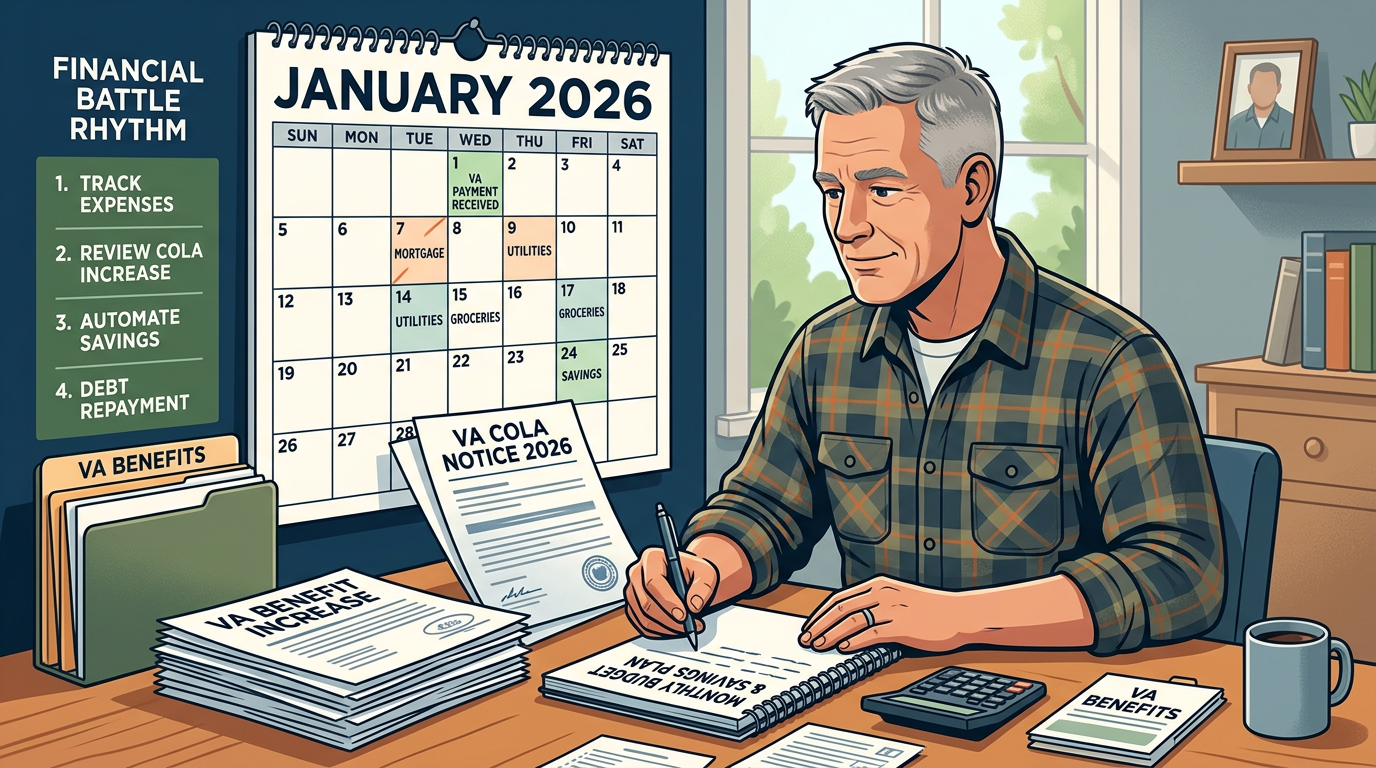
Set a recurring calendar reminder for the same day each month. The 5th works well because most VA deposits have cleared by then. The review should take five minutes. Here is what you check:
Did the VA deposit post at the correct amount? Occasionally, payments get delayed or adjusted. Verify the amount matches what you expect based on your rating and dependents.
Did the automatic transfers execute? Check your savings account, credit card, and investment account to confirm the money moved. If a transfer failed (insufficient funds, expired routing number, closed account), fix it immediately.
What is my cash reserve balance in months of coverage? Take your reserve balance and divide it by your essential monthly expenses (rent, utilities, food, insurance, transportation). If the number is below two, keep the current allocation. If you have crossed two months, consider shifting more toward debt or growth.
What is the current balance on high-interest debt? Track this number monthly. Watching it go down, even slowly, reinforces the behavior. If you paid off a card or loan, redirect that bucket's share to growth.
Am I on track for my 90-day target? Set a simple 90-day goal at the start of each quarter. Something like "reduce credit card balance by $150" or "grow savings to $1,500." Check progress monthly. Adjust effort if you are behind.
Setting Up Automatic Transfers
Most banks let you schedule recurring transfers through their app or website. Here is the setup for each bucket:
For the cash reserve transfer, set up a recurring monthly transfer from your checking account to your savings account. Schedule it for 1-2 days after your VA deposit typically arrives. Set the amount to your cash reserve allocation (e.g., $26).
For debt reduction, most credit card issuers allow you to schedule extra payments. Log into your credit card account and set up a recurring additional payment. Make sure this is on top of your minimum payment, not replacing it. Some issuers let you schedule payments through autopay settings; others require you to manually set recurring payments through bill pay at your bank.
For the growth bucket, open a Roth IRA or taxable brokerage account if you do not already have one. Fidelity, Schwab, and Vanguard all offer accounts with no minimums and no fees on their index funds. Set up automatic monthly contributions. Pick a single target-date fund or total market index fund to start. You can optimize later. Getting the money in is what counts now.
When Unexpected Expenses Disrupt the Rhythm
They will. A car repair hits in March. A medical copay surprises you in June. This is normal.
If the expense can be covered by your existing budget without touching the COLA allocation, cover it and keep the rhythm going. If the expense forces you to pull from savings or skip a transfer, do what you need to do. Pause the automatic transfers for one month if necessary. Then restart them the following month.
The key is to restart. Missing one month is not a failure. Abandoning the system because you missed one month is. Think of it like PT. You skip a day, you do not quit the program. You show up the next day.
If you find yourself pausing transfers repeatedly (more than twice in six months), that is a signal that your base budget needs attention. The COLA allocation assumes your regular expenses are covered by your regular income. If they are not, the first priority is stabilizing the base budget before allocating the increase.
Bottom Line
The 2026 COLA increase is small enough to ignore and consistent enough to matter. The difference between veterans who build wealth over time and those who stay in the same financial position year after year often comes down to what they do with these small, recurring adjustments. Pick your buckets. Set the transfers. Review monthly. That is the entire system, and it works because it removes the need for willpower on a daily basis.
If you want help building a benefits-based financial plan, Command can walk you through allocation strategies tailored to your rating and situation.