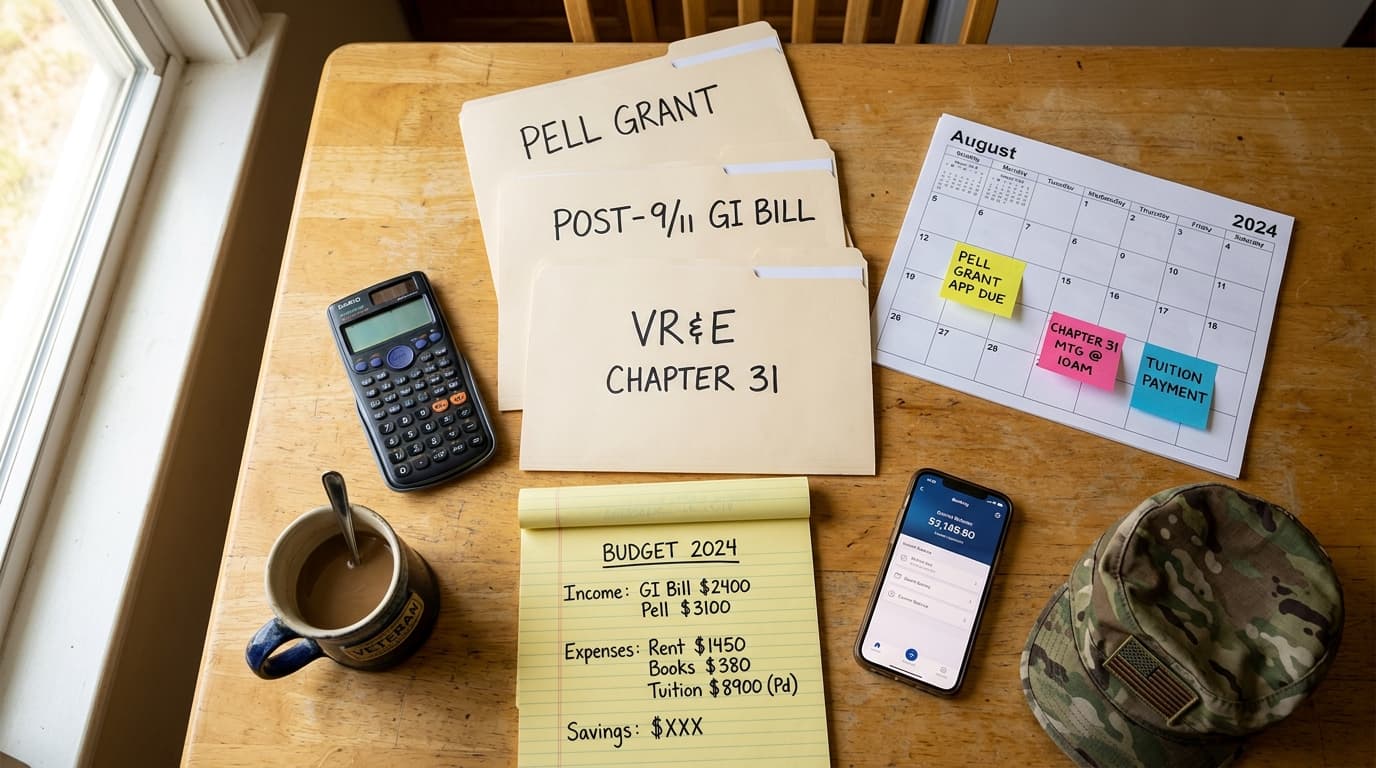
A lot of veterans think education aid stacks like cash in an envelope. Pell goes in, GI Bill goes in, VR&E goes in, you shake the envelope, and you spend whatever comes out. I get why that thought lands. The award letters all show big numbers. The school is excited to enroll you. The financial aid office mentions Pell while VA is approving Chapter 31 and your COE just got updated to show Post-9/11 GI Bill months. Three good answers arrive in the same week and it feels like a windfall.
Then the semester actually starts. Tuition is paid but the books bill is not. MHA is sitting at the end of the month while rent is due on the first. Pell got applied to the school account but the refund has not been cut yet. VR&E subsistence is on its own clock. The award letters were all real. The cash was just never going to land in the order you assumed.
If you are heading into a 2026 term using any combination of Pell, GI Bill, and VR&E, the goal of this post is simple. Tell you what each one actually covers, when the money shows up, and how to stack them without writing the same dollar into two different budget lines.
Why veterans assume aid stacks like instant cash
I do not think this is a money-skills issue. I think it is a wording issue. Every program in this stack is described to you as money you have been awarded. Pell says award year. GI Bill says benefit. VR&E says subsistence allowance. The brain rounds all of that into "this is mine, it is coming, I can plan against it." That is not wrong. It just hides the part that matters: who hands you the dollars, and on what day.
Two facts cut through most of the confusion. First, the Federal Pell Grant page is explicit that the amount of other student aid does not affect the amount of your Pell. Pell does not get clawed back because you also have a GI Bill or because you are on Chapter 31. Second, the same page makes clear that a school can apply Pell funds to school costs, pay you directly, or do a combination. You are not the one deciding the path that money takes. The school is.
Read those two together. You can be Pell-eligible at full freight even while VR&E is paying your tuition. That does not mean Pell is going to appear in your checking account on day one. It might land at the bursar's office and never touch you. It might sit there until the school cuts a refund. It might cover a fee that VA did not. Until you see the bursar statement after disbursement, you do not know.
That is the trap. Three lines on a page get treated like three deposits in a bank, and the budget assumes all three are spendable cash. They are not. Some of it is tuition credit. Some of it is a stipend. Some of it is a refund. They land on different days for different reasons, and at least one of them might never hit you directly at all.
What each benefit actually covers
Forget the brochures for a minute. Here is what each program is actually doing in 2026 in plain English.
Federal Pell Grant. For the 2026-27 award year, the maximum Pell is $7,395. Eligibility depends on your Student Aid Index, the school's cost of attendance, how many credits you are enrolled in, the length of the academic year, and how much Pell lifetime eligibility you have left. Pell is not loan money. It does not have to be repaid in the normal case. And it is a Title IV federal grant administered by Federal Student Aid, not by VA. The school can apply it to your charges, pay you directly, or split it. You cannot receive Pell from more than one school at the same time.
Post-9/11 GI Bill. For the August 1, 2025 through July 31, 2026 rate year, VA sends tuition and fees directly to the school or training program. You do not see that money. What you see is the Monthly Housing Allowance, paid at the end of each month, and the books and supplies stipend, paid up to $1,000 per academic year. MHA does not pay if you are half-time or less, on active duty, in correspondence or flight training, or on break. Online-only learners who started using the benefit on or after January 1, 2018 can receive up to $1,169 a month. That is a real number to plan around, but it is also smaller than a lot of in-person MHA rates, and it pays on the same end-of-month clock.
VR&E, Chapter 31. VR&E helps veterans with service-connected disabilities figure out a path to employment, including education or training when that is part of the plan. Tuition, fees, books, and required supplies for an approved program are paid by VA, not by the veteran. A subsistence allowance lands separately. For veterans on a long-term education track inside VR&E, that subsistence can look like Post-9/11 MHA — but it does not always. Paralyzed Veterans of America's testimony to the House Veterans' Affairs Committee on May 20, 2026 noted that many VR&E veterans receive around $700 a month in housing and expense support and that not all of them get the full Post-9/11 GI Bill-style housing allowance. Plan against the number on your own award letter, not the assumption that VR&E pays the same as the GI Bill.
The blunt summary. Pell can put cash in your hand if there is a credit balance left after the school applies it. GI Bill puts tuition at the school and a monthly housing check in your account. VR&E pays the school directly for school costs and adds a subsistence allowance on top. None of those three deposits are scheduled to arrive on the same day. None of them are interchangeable.
Disbursement timing, and why the gaps wreck rent and book money
This is the part veterans miss most often. The Federal Student Aid receive-aid page is direct: the school distributes federal aid, not the Department of Education. Grant and loan money is generally disbursed in at least two payments, and in most cases at least once per term. The school first applies that money to tuition, fees, and room and board if you live on campus. Anything left over is paid to you directly. If you end up with a credit balance, the school must pay it to you within 14 days unless you authorize the school to hold it for future charges.
That 14-day window is the silent killer of move-in budgets. The semester starts. Pell is disbursed. The school applies it. A credit balance shows up on your account on a Tuesday. By federal rule, the refund is in your hand by two weeks later. Two weeks is half a month. Rent does not wait two weeks. Groceries do not wait two weeks. Your phone bill does not wait two weeks.
Schools that take Title IV money also have to give eligible students a way to obtain books and supplies by the seventh day of the term if the credit balance timing lines up. That is a real lifeline, and a lot of veterans never use it because they did not know it existed. If the financial aid office has not told you about it and you are short on book money, ask.
Now layer in the other two. GI Bill MHA pays at the end of the month, every month, prorated for partial months. VR&E subsistence has its own schedule from VA, separate from MHA and separate from Pell. The school's Pell refund is on the school's clock. So a veteran moving in around August 20, with classes starting August 25, is looking at this real picture:
- Tuition is handled either by GI Bill or VR&E, but you never touch that money.
- Books and required supplies are either handled by VR&E or by the GI Bill stipend, but the stipend cap is $1,000 for the whole academic year.
- The Pell refund, if any, is coming within 14 days of the school's disbursement, not within 14 days of the day you moved in.
- The first MHA deposit is at the end of August at the earliest, and it is prorated because you were not enrolled for the full month.
- VR&E subsistence, if you are on Chapter 31, lands on VA's calendar, which is its own thing.
If you wrote all three benefits into a single August budget as if they were one deposit, August is going to hurt. Not because the benefits failed. Because the calendar did exactly what it was always going to do.
What recent 2026 VR&E policy chatter actually says
There is a fair amount of chatter right now about VR&E. Most of it traces back to a hearing in front of the House Veterans' Affairs Committee on May 20, 2026, where Paralyzed Veterans of America submitted written testimony on changes that have been proposed for Chapter 31. A few pieces of that testimony are worth understanding plainly, because some of them are facts about how VR&E and Pell interact today, and some of them are about a proposal that has not become law.
The facts about how things work today. PVA noted that veterans using VR&E for long-term education may also be eligible for Pell Grants from Title IV funds. That is not unusual — it just confirms what the Federal Student Aid page already says about Pell not being reduced by other aid. PVA also pointed out that VA does not track Pell Grants and does not require veterans on VR&E to report them, and that Pell dollars are issued directly to the institution where the veteran is enrolled. None of that is a loophole. It is just how the two systems are wired.
The piece that is policy chatter, not law. PVA criticized a proposed $250,000 federal-funds cap and warned it could create real burdens for some disabled veterans on Chapter 31. That is testimony in front of a committee. It is not a rule, not a regulation, and not a change to the way VR&E currently pays. Do not budget against a number that exists only in a proposal. Read the testimony if you want the context, then build your plan against your actual award letter from VR&E and the actual Pell amount your school confirms.
The honest takeaway here: proposed legislation moves slowly and changes shape. Anyone telling you to plan your 2026 semester around a $250,000 cap, or around a rule that the GI Bill housing rate is about to become the VR&E rate, is jumping ahead of the system. Plan against today's award letters, today's MHA rate, and today's Pell number.

A practical cash-flow plan that does not double-count any dollar
The whole goal of stacking three benefits is to cover your real costs without telling yourself the same dollar is in two places. Here is the order I run it in for veterans who are mixing Pell, GI Bill, and VR&E.
1. Identify which benefit is paying your tuition. Only one is. If you are on VR&E for an education plan, VR&E pays tuition, fees, and required books and supplies. The GI Bill is not also paying tuition on top of that. If you are using the GI Bill, VA pays tuition and required fees up to the published cap for the school type, and VR&E is not also covering it. Pell never functions as your tuition source by default — it is general federal aid that the school applies wherever it makes sense, usually starting with tuition and fees if those are not already covered. Pull your bursar statement after disbursement and confirm which line paid which charge. If you are guessing, you are not stacking. You are hoping.
2. Identify which benefit is paying your housing and living expenses each month. If you are on Chapter 31, your subsistence allowance is from VR&E. If you are on the GI Bill, your housing money is MHA. You do not get both for the same month for the same program. Write down which one you are on, what the amount is, and which day of the month it lands. That number is your monthly anchor.
3. Treat Pell as the variable, not the foundation. Pell may show up as a refund. It may not. It depends on what the school applied it to and whether there is a credit balance left. Do not assign Pell to rent, groceries, or utilities until you have the bursar statement showing a refund check is scheduled. Once it does land — within 14 days of the credit balance per the rules — drop it onto a real cost: a laptop you actually need, a books overflow above the GI Bill stipend cap, a debt you want to clear before MHA starts. Concrete uses, not vague plans.
4. Walk through the first 30 days line by line. Move-in costs. Rent for the first month. Utility setup. Renters insurance. Books and supplies above what your benefit will cover. Groceries, gas, phone. The first MHA or subsistence deposit is at the end of the month, prorated if you started after the first. The Pell refund is on the school's clock, not yours. The cash you have today is what is paying for the days between move-in and the first deposit. If the math says the cash is short, you do not need a third benefit. You need a delay, a tighter rent, a smaller move, or a real cash buffer set aside before the term starts.
5. Never write the same dollar into two budget lines. This is the rule that sounds obvious and gets broken every semester. If Pell is going toward a laptop, it is not also going toward rent. If MHA is paying rent and utilities, it is not also paying for the new tires you need by October. If VR&E subsistence is covering groceries and the phone bill, the next time you tell yourself "and I can also cover gas with it," ask which line you are taking from. Either the number works on paper or it does not.
What to protect first when the cash gets tight
If the first 30 days look thin even after the math, the order in which you protect bills matters more than the optimism about future deposits.
Rent and utilities come first. Late rent never gets cheaper. Phone and transportation come next, because you need both to verify enrollment and get to class. Food and any required prescription come right after. Tuition and books are typically already handled by VR&E or the GI Bill — if a school bill is showing you owe out of pocket, call the school certifying official before you eat into rent or grocery money to plug something that may not be yours to pay.
The thing not to do, in this whole stack, is borrow against future MHA or future Pell from a payday or "tuition advance" lender. The interest math is brutal and the cash crunch they are solving is one the system is going to solve in two to four weeks anyway. If you are actually that tight, the better calls are the school's financial aid office for emergency aid, an SSVF provider for housing-related help, and the VR&E counselor if you are on Chapter 31 and something on the plan is not paying the way it is supposed to.
Questions to answer before the term starts
Run these in writing, not in your head, before move-in. Save the page somewhere you can find it again on a bad Tuesday.
- Which benefit is paying my tuition this term, GI Bill or VR&E? Confirmed by the school in writing?
- What does my bursar statement look like after the school applies Pell, GI Bill tuition, or VR&E tuition payment? Any balance left?
- If Pell produced a credit balance, when is the school cutting the refund, and how is it being delivered?
- What is my MHA or VR&E subsistence rate, and which day of the month does the first prorated deposit hit?
- Which exact charges am I paying out of pocket from move-in through the first deposit? Rent, utilities, books overflow, groceries, transportation?
- Do I have a separate buffer that equals one month of MHA or subsistence in case verification, certification, or a school delay pauses a payment?
- Is there any line item in my plan that I have assigned to two different benefits?
That last one is the most important question on the list. If a dollar is in two places, the budget is fiction. Find it, fix it, then look at the page again.
Download the education cash-flow checklist
I put together an education cash-flow checklist that walks every line above. The tuition source. The monthly housing or subsistence line. The Pell refund window. The first-30-days cash gap. The buffer for a paused payment. A separate column for the question "did I write this dollar in twice." It is the page I wish someone had handed me the first time I tried to combine federal student aid with a VA education benefit.
Download the education cash-flow checklist and run the numbers before the term starts, not the week rent is due.
Pell, the GI Bill, and VR&E are all real, and they can all show up in the same semester. They are not, however, one single deposit. Treat each one as its own clock, plan against the dates and amounts on your actual award letters, and stop writing the same dollar into two budget lines. The benefits are doing their job. Your job is to keep track of which one is paying for what.
Sources: Federal Student Aid, Federal Pell Grants (studentaid.gov/understand-aid/types/grants/pell); Federal Student Aid, Receiving Financial Aid (studentaid.gov/complete-aid-process/receive-aid); VA Post-9/11 GI Bill rates effective August 1, 2025 to July 31, 2026 (va.gov/education/benefit-rates/post-9-11-gi-bill-rates/); VA Veteran Readiness and Employment, Chapter 31 (va.gov/careers-employment/vocational-rehabilitation/); Paralyzed Veterans of America statement to the House Veterans' Affairs Committee, May 20, 2026 (docs.house.gov/meetings/VR/VR00/20260520/119305/HHRG-119-VR00-Wstate-BrownM-20260520.pdf).